How a Finance or Ops Department Workflow Tear-Down Unfolds Across Capital Delivery Environments
A three-step tear-down exposes where declared plans diverge from actual work.
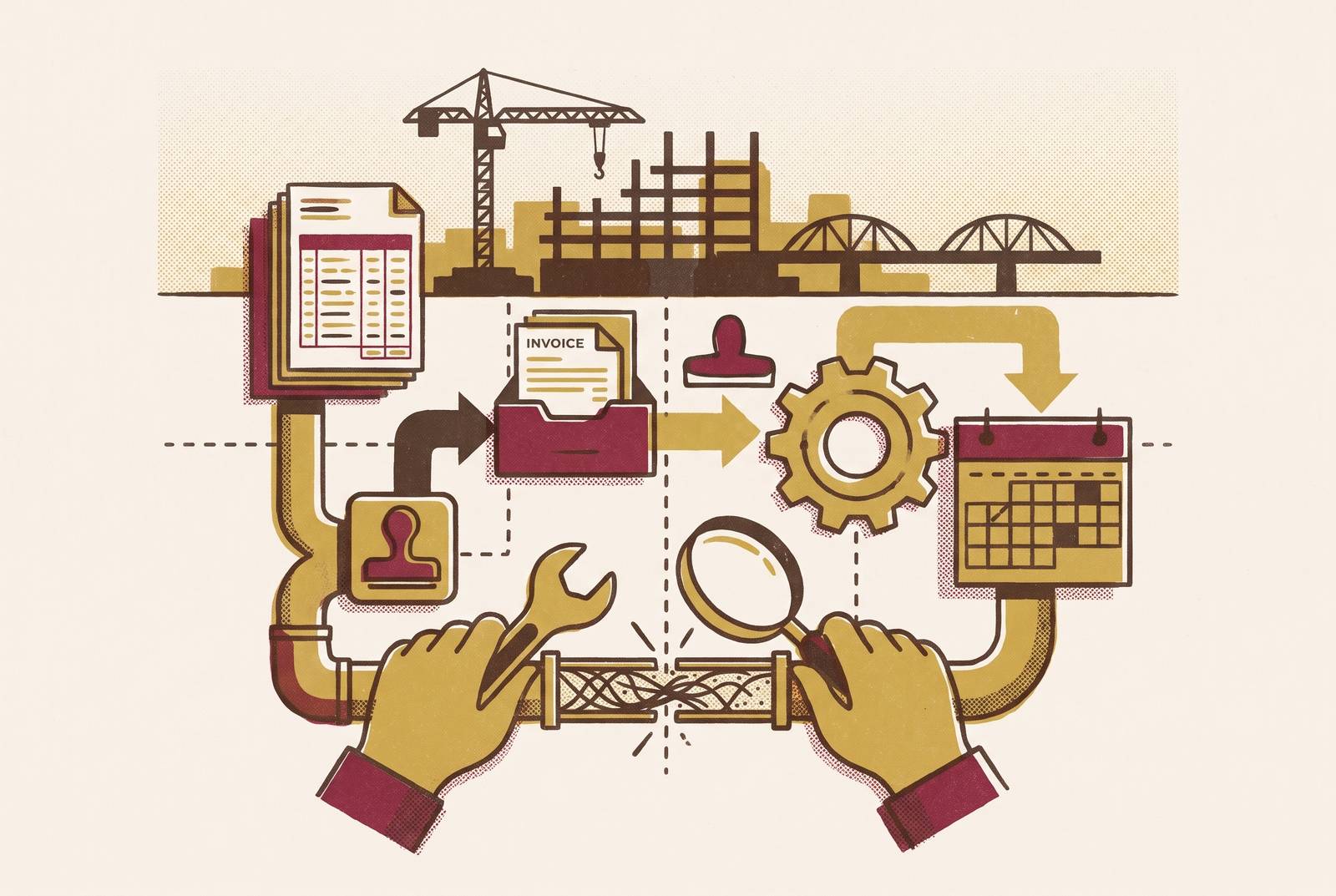
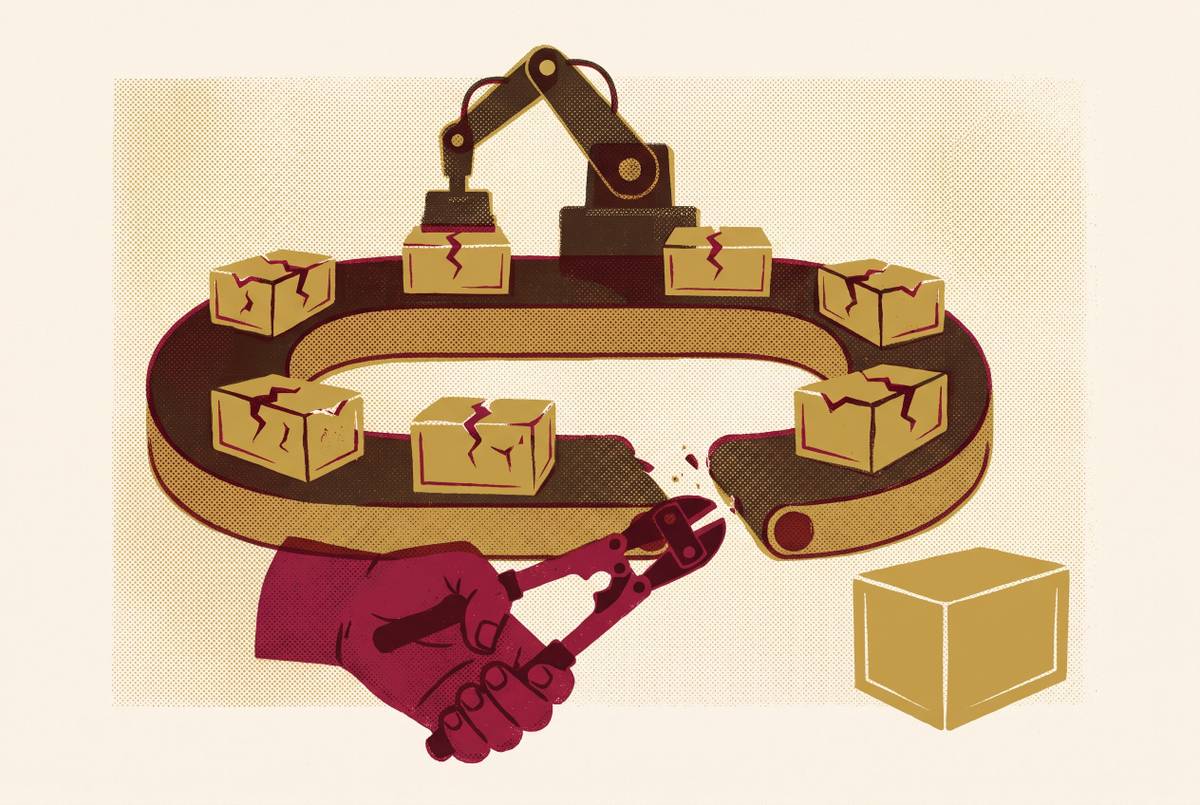
Rebuilding department workflows with AI agents from scratch requires an ordered tear-down. The method is task decomposition, process audit, then agent-centered redesign. Across capital delivery environments, that sequence must expose the gap between declared plans and actual work, because the most consequential failures occur between functions that share a delivery outcome but operate separately.
Why the tear-down sequence exists and what makes it different from process improvement
A workflow tear-down questions the structure of work. Conventional automation can speed up work while keeping handoffs it does not need, leaving it unclear who has authority, and using inputs that cannot be trusted. Legacy processes often lack machine-readable definitions, clear policy constraints, and structured data flows, so an agent has no sound framework to work within.
Agent-first design reverses the starting point by working backward from the required outcome. It establishes what an agent can handle autonomously, reserves judgment for humans, and then defines the handoffs between them. Autonomy is not an all-or-nothing choice. Suggest-only, propose-and-approve, and execute-with-rollback modes belong to different task risks, and assigning the wrong mode is itself a design failure. Those decisions depend on understanding the tasks and auditing their actual execution first, so the tear-down only works as a sequence.
How do you redesign a department workflow using AI agents through task decomposition, process audit, and agent-centered redesign?
Task decomposition breaks a workflow into discrete, atomic tasks and classifies each by the actor best suited to perform it. Data retrieval, matching, policy checks, decision proposals, and transaction initiation are common agent candidates. EdgeVerve describes an Infosys accounts receivable deployment with seven agent personas handling work from invoice tracking to payment pattern analysis.
Process audit then checks how those tasks happen in practice. Documented procedures are the starting claim. In capital projects, the audit traces broken documentation, bypassed approvals, late field inputs, and points where audit evidence becomes difficult to assemble. Its deliverable is a map of divergence between declared and actual process. That map identifies which handoffs, controls, and dependencies the redesign must change.
Agent-centered redesign uses those findings to rebuild work around continuous activity and parallel execution. The outcome determines the structure of the workflow. Humans oversee decisions that need judgment, while agents do the bounded work found during decomposition. Running all three in parallel, or compressing them into one workshop, removes the evidence needed to distinguish necessary controls from inherited friction.
Why capital delivery environments warp the sequence in ways generic AI guidance ignores
Construction, infrastructure, energy, and project finance involve teams whose separate decisions converge on one delivery commitment. Procurement can go ahead without input from construction, logistics planning can start only after equipment is delayed, and commissioning can be left out of early planning. These are failures of coordination. A department-level audit that stops at the department boundary can therefore miss the dependency responsible for its poor results.
BCG’s energy company case illustrates how isolation compounds. Insufficient early engagement from senior asset owners, a compressed design phase, and siloed engineering contributed to design problems. Low-cost labor and poor coordination between trades then contributed to execution failures and rework. The audit must trace how an upstream decision changes what another function can actually deliver.
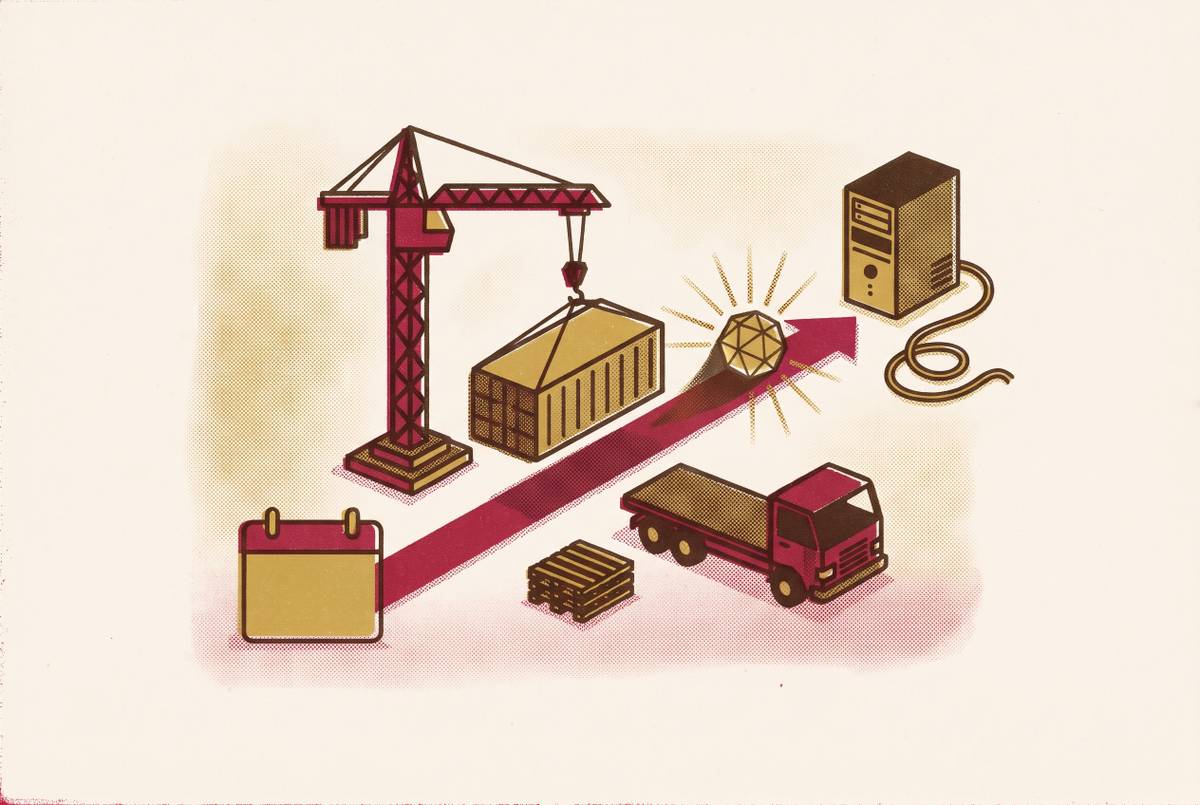
Roughly 16 GW of new US data center capacity was announced for a 2026 commercial operation date, but only 5 GW was under construction at the time of announcement. A declared date is not delivery evidence. In this setting, decomposition must include external dependencies, while the audit must distinguish an approved assumption from a constraint that has actually been resolved.
What the tear-down looks like inside project finance and cost controls
In finance, decomposition separates data gathering and preparation from the analysis that informs decisions. Agent candidates include consolidation from ERP and CRM systems, first-draft forecasts and variance narratives, scenario analysis, and management reporting. Testable, reproducible forecasting and anomaly detection belong upstream, while generative narrative drafting belongs downstream of verified numbers. Reversing that order allows plausible language to conceal an unsupported financial claim.
The audit then follows the actual decision chain into board decks, covenant compliance calculations, and compensation models. It identifies where generated figures could enter those outputs without human verification. A plausible error can be especially dangerous here. Unlike a visible failure, an invented margin figure may pass into a consequential decision because it looks complete. The audit output must therefore identify both the data source and the verification point.
Redesign changes responsibility as well as elapsed time. An agent coordinates defined tasks through the workflow, while an additive copilot mainly helps one person do an existing task faster. Finance teams in capital delivery may have an EPM platform and still rely on critical Excel models, so the rebuilt process must work with both. Grounding generated figures in verified sources, with references to the underlying ledger or warehouse query, is a core design output.
What the tear-down looks like in field operations and construction execution
Field-to-finance data flow is an operating process. Field teams generate information through manual reports, paper logs, and disconnected digital tools, while finance depends on periodic inputs for billing, cost tracking, and forecasting. The mismatch creates a consequential recognition lag. Decomposition must follow a progress report from field submission through validation to financial recognition, treating the work of preparing the report and billing as linked tasks.
The audit examines both timing and accuracy along that path. A report may take days to reach financial recognition, even when the underlying work has already occurred. Earlier validation changes the workflow’s point of control. Cross-referencing progress against schedules, material deliveries, and labor logs can flag discrepancies before billing. Change orders need the same checks because the parties who negotiate them, share supporting documents, and deal with their effects on costs and schedules may use separate systems.
Redesign puts those checks into the flow of work as new field data comes in. Financial implications must reach the ERP system. Otherwise, the coordination gap remains largely intact. Suffolk and MIT modelled six AI-enabled levers against a completed $180M project and found potential cost and schedule gains from combined workflow changes. Their caveat supports the structural argument, because meaningful improvement required multiple workflows to change together rather than another tool being added to the existing process.
What the tear-down looks like in procurement and supply chain coordination
The energization readiness gap begins when capital approval assumes power availability that the interconnection queue does not validate. Facilities teams then order equipment and phase construction against a deadline the grid operator does not recognize. Procurement inherits an assumption as a commitment. A process audit must compare procurement decision timing with grid interconnection queues, transformer lead times, and permitting schedules before those dependencies become schedule events. A reported five-year backlog for high-voltage transformer orders shows how far an approved plan can separate from its actual delivery path.
Decomposition distinguishes constraint sensing from procurement execution. Monitoring lead times, supplier variability, queue position, and permitting status creates a different task category from vendor selection, negotiation, and approval routing. Continuous sensing can bring constraints to light between reviews. Humans oversee execution decisions because they must answer for the commercial outcomes of the work agents do. The redesign’s principal output is earlier visibility into what the project cannot yet deliver, rather than faster processing of an order based on an untested assumption.
Jacobs’ survey of 600 senior energy decision-makers found that most thought there was enough capital, while far fewer saw enough investable projects. Available funding does not establish an executable project. Permitting, grid capacity, and dependencies between infrastructure systems can keep work from reaching construction even when it has funding. BCG’s lithium extraction plant case illustrates a different sequencing logic, with pressing design decisions made first, other decisions deferred until more data became available, and long-lead items prioritized. For procurement redesign, that logic places dependency assessment early enough to inform construction and commissioning planning from the FEED phase.
What the tear-down looks like at startup and commissioning, where most schedule risk actually lands
Commissioning is where procurement, field execution, logistics, and financial controls must finally synchronize. Unresolved gaps become hard constraints on readiness. Late planning leaves little room for correction. Decomposition must therefore spell out the work of readiness tracking and integration risk assessment instead of assuming that completing construction takes care of it. The audit must ask whether the way work is going still allows the project to meet its declared startup date.
The TerraPower and Bechtel situation illustrates that distinction. Construction began in April 2026, but by September 2026 the owner and EPC contractor had separated on the next phase, while TerraPower maintained its public schedule and Bechtel scoped down to limited work. The declared timeline and contracting position had diverged. More generally, a stalled core technical dependency or continued budget burn while physical progress slows can signal that a project’s approved path no longer matches its operating condition. Those signals are more useful before commissioning than during it.
BCG’s energy company remediation used digital twins to identify integration risks early and AI models for simulation and scenario planning. The timing of risk detection was the essential change. Agentic readiness tracking and dynamic prioritization extend that logic by making commissioning planning a parallel track from FEED rather than a sequential deliverable after mechanical completion. Human approval remains essential for high-stakes decisions such as large change orders and final closeouts. Readiness becomes a continuous process, with stronger governance as the project approaches its delivery commitment.
Accenture Construct and what a full-lifecycle delivery model signals about the direction of the market
Accenture launched Accenture Construct in September 2026 to help owners plan, deliver, and optimize large infrastructure and capital projects. Its remit spans airports, power grids, data centers, rail networks, and advanced manufacturing facilities. The operating model is the relevant market signal. One partner who is accountable across the project lifecycle can tackle fragmented delivery by addressing each function’s need for tools as part of the whole.
That model aligns with the tear-down’s focus on value lost at coordination handoffs. It does not make every engagement a full-lifecycle transformation. A field-grounded partner can occupy a more specific position by starting with a painful process, establishing how work actually moves, and rebuilding it before expanding the scope. The useful distinction for buyers is therefore not simply software versus consulting. It is whether the engagement produces an audited, functioning workflow or remains at the level of platform selection and broad transformation planning.
Where to start and what to expect as an operations leader
A specific, painful process that is frequent, rule-heavy, and measurable provides a practical starting point. In capital delivery, field-to-finance data flow and procurement constraint sensing are strong candidates because their failures are visible and their improvements can be measured. Tool selection follows the audit. Choosing the outcome that needs rebuilding comes first, followed by decomposition of the work and investigation of the gap between procedure and practice.
A live first process within weeks is the useful early signal. That milestone differs from productionizing a broader finance deployment, for which a 90-day pilot and six to nine months to productionize provide a longer frame. An audit that surprises leadership, agents working inside the process, and live outputs that can be measured show that the work is moving forward. A platform roadmap without a rebuilt process, tools chosen before the audit, or a quarter without live operation indicate that the effort may have drifted away from its original purpose.
Governance belongs in that first operating version. Cost-to-serve, cycle time, and risk performance must be clear to see, while humans must use their judgment on high-stakes decisions. Once the first process is live, its operational data gives the next audit a more precise view of actual work and makes the next redesign faster.