Long-Lead Equipment Procurement Failures in EPC Projects
Equipment shortages force EPC firms to order years before design is complete.
Most EPC contracts still describe a sequence that no longer holds. Plan, permit, procure, build: that order governed how utilities and engineering firms moved money and risk for decades, and it made sense, because it matched capital commitment to project certainty. Equipment commitments now have to happen before the engineering decisions that were supposed to determine them, and the old order has been overturned in practice even where it remains the written standard. The gap between the contract and the field is the subject of this piece.
The sequence that's being replaced was deliberate. Utilities ran feasibility studies, secured permits, negotiated power purchase agreements, and only after those steps locked in did procurement teams start placing equipment orders tied to a stable design. Power Magazine's November 2025 analysis named this the model now on the edge of inversion, and the phrase is apt because inversion is what has happened: the step that used to come last now has to come first.
Three forces pushed the sequence into reverse at the same time. Geopolitical tension and tariff volatility made the cost and availability of major equipment unpredictable enough that waiting to place an order carries its own risk. Gas, nuclear, and renewables projects are now competing for the same limited pool of capital and skilled labor, which tightens every procurement window at once. Electricity demand from AI and data center growth is one of three converging disruptions, alongside geopolitical tension and tariff volatility making equipment cost and availability uncertain and competition between gas, nuclear, and renewables for limited capital and skilled labor, all documented at the Energy Projects Conference Show 2025 in Houston. All three trends were laid out at the Energy Projects Conference Show in Houston in 2025, and together they explain why equipment procurement no longer waits for design to finish.
The clearest sign of the reversal is a specific and strange piece of field behavior: firms are paying a premium to secure production slots for major equipment before they've picked a project site. It's a rational response to a supply environment where waiting for site selection, permitting, and engineering to finish means missing the equipment order window. Every procurement plan built around sequential engineering-to-procurement flow assumes an order of operations that the market has already abandoned.
Why transformer lead times reveal the inversion
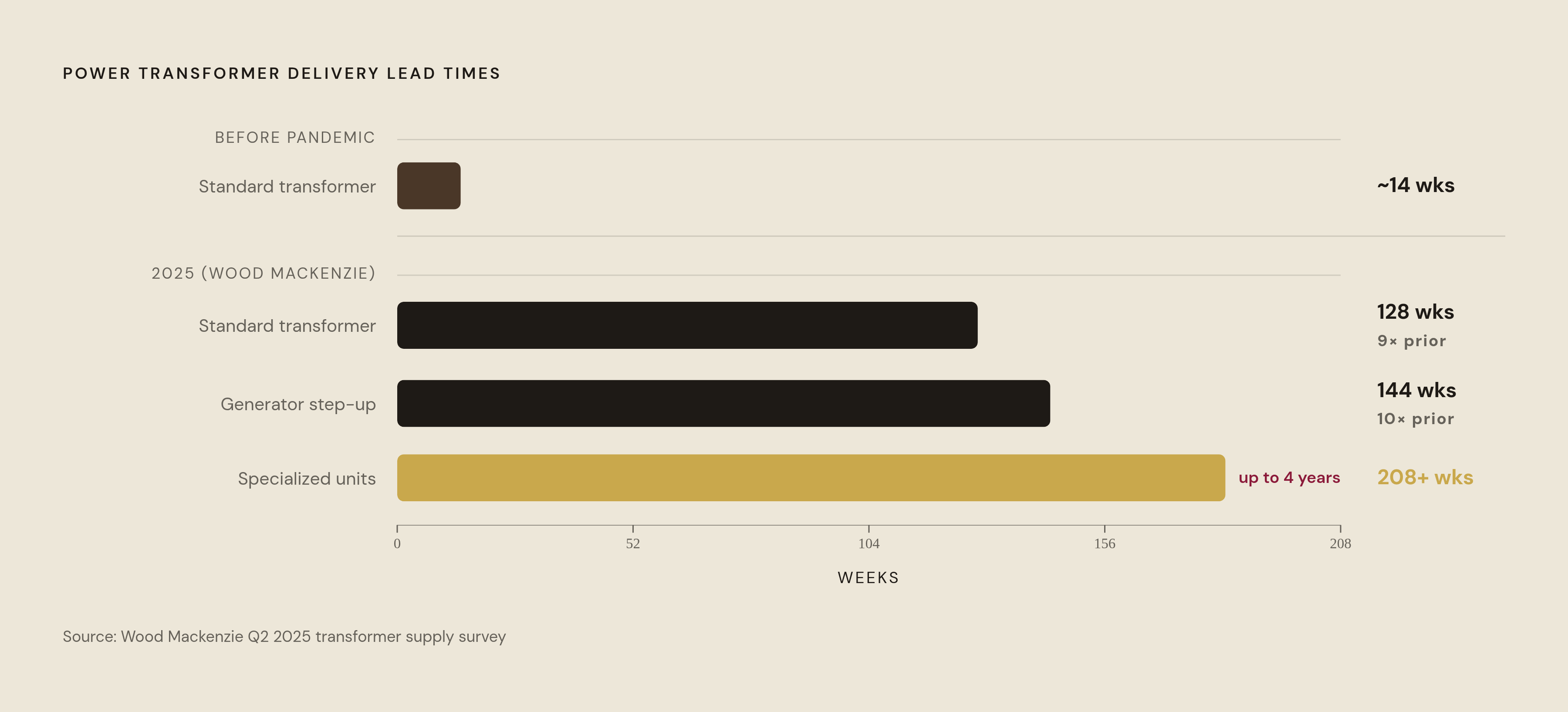
No single component makes the inversion more visible than the power transformer. Before the pandemic, a standard power transformer took 12 to 16 weeks to deliver, a timeline that fit comfortably inside a normal permitting and design cycle. Wood Mackenzie's second-quarter 2025 survey put the current average at 128 weeks for standard power transformers and 144 weeks for generator step-up transformers, with some specialized units taking as long as four years. A wait measured in weeks has become a wait measured in years, and no permitting timeline, financing close, or engineering review runs on that clock.
The demand side of that shortage is not a single spike from one industry. AI data center load, the electrification of transport, and industrial reshoring are all pulling on the same transformer supply chain simultaneously. Wood Mackenzie's data shows demand for generator step-up transformers grew sharply between 2019 and 2025, and substation transformer demand has followed a similar path. These are three separate, durable trends stacking on top of one another that will persist even after any one sector's buildout slows.
The obvious question, given a shortage this severe, is whether it's a matter of finding new suppliers or shortening the domestic supply chain. Roughly 80% of large power transformers used in the U.S. are imported, making the constraint a global manufacturing capacity problem exposed to geopolitical and trade risk. The bottleneck sits in global manufacturing capacity, exposed to the same tariff volatility and geopolitical tension driving the broader inversion, so no amount of domestic logistics improvement touches the actual constraint.
The single-material chokepoint that makes the transformer shortage structural rather than cyclical
The transformer shortage traces back to one manufactured material: grain-oriented electrical steel, known in the industry as GOES. In the United States, exactly one mill produces it, Cleveland-Cliffs' Butler Works facility in Butler, Pennsylvania. That single point of domestic supply is the constraint behind every delayed transformer order placed by a utility or EPC firm in the country.
This is not a problem procurement software or better vendor management can solve. Expanding steel-making capacity takes years of capital investment and construction. Transformer manufacturers are building new capacity, with close to $2 billion committed to expansion.
The financial consequence has already landed. Component prices tied to this shortage have risen sharply over the last five years, PV Magazine reported. That cost exposure hits early, before a project's scope is even fixed, and there's no later stage of the project where it can be recovered. Once the material constraint is understood, the next question follows naturally: if the equipment itself is scarce and expensive this far in advance, who gets access to it, and on what terms.
GE Vernova's backlog and Entergy's advance commitments, and project access
Equipment slot access has become the mechanism that decides which projects can move forward, and it now operates independently of how ready a project's engineering or financing actually is. Organizations that committed early hold positions that structurally block out everyone who moved later, regardless of the latecomers' technical readiness.
GE Vernova's third-quarter 2025 earnings call, held October 22, reported 12 GW of new gas turbine orders in that quarter alone, following 9 GW in the second quarter, which pushed the company's total gas power backlog, including slot reservation agreements, to 62 GW. A backlog that size is a direct measure of how many downstream EPC teams failed to secure their equipment position early enough and are now waiting behind everyone who did.
Entergy offers the clearest look at what acting early actually looks like in practice. Entergy, responding to a data center demand pipeline that expanded to 7–12 GW in its Gulf Coast territory in a single quarter, has already secured more than 19 GW of generation components and 90% of materials required for transmission projects through 2030, acting on projects that have not yet received full approvals. American Electric Power has taken the same approach, locking in 8.7 GW of gas turbine capacity and new high-voltage equipment agreements ahead of its own approval cycles, backed by a substantial multi-year capital plan already committed.
Michael Novev of Burns and McDonnell, speaking at a Reuters Events conference, described exactly the behavior this pattern produces: firms purchasing production slots before they've even finalized a project site. That procurement behavior has no precedent in the traditional EPC sequence, reflecting displacement rather than utilities being unusually forward-thinking. It's a story about displacement. Every slot Entergy, AEP, or GE Vernova's customers secure early is a slot that a slower-moving developer will not get, and that developer's project doesn't fail because its engineering is weak. It fails because it entered the queue after the queue closed.
Why the inversion hits data center timelines hardest
No sector feels the collision between old assumptions and new lead times as sharply as data centers. Developers in this space plan and finance projects on timelines that assume power infrastructure will be available when they need it, and that assumption no longer holds anywhere close to reliably.
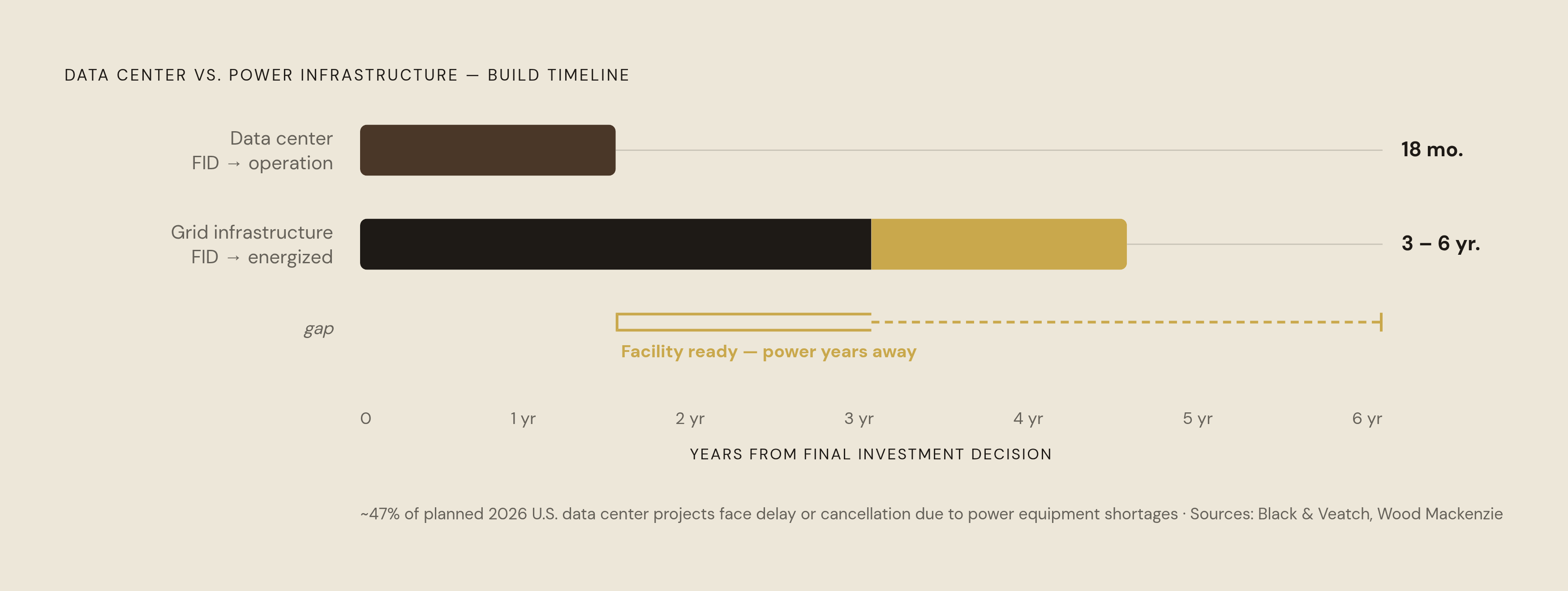
Black & Veatch's Electric Report found that data centers now move from final investment decision to full operation in about 18 months, while the grid and power infrastructure needed to actually serve them can take three to six years to deliver. That gap, a facility ready to switch on years before the power it needs is ready to deliver, is the core mechanism behind failures in this sector.
Meta's build-out illustrates the scale of the mismatch. Its gigawatt-scale AI campuses, including the Richland Parish project, are targeting roughly 2 GW online by 2030 and full build-out around 2032, with phased commissioning aimed at bringing some mission-critical zones online in well under three years. There is no version of that schedule that works if procurement waits for engineering to finish first.
Dominion Energy is running the largest simultaneous generation and transmission buildout in its history for exactly this reason. Roughly 47 GW of data center demand now is in various stages of contracting with the utility, up significantly from the prior year and concentrated primarily in Virginia. U.S. data center electricity demand is expected to grow substantially through the end of the decade, and utilities like Dominion are the ones absorbing that growth in real time, not on a projected future curve. The consequence of the mismatch between demand growth and equipment supply is already visible in project outcomes. Wood Mackenzie found that nearly half of planned U.S. data center projects in 2026 face delay or cancellation because of power equipment shortages, a count of projects already failing rather than a forecast.
The sequencing layer, not the transaction layer, is where the process breaks
Most of the attention paid to EPC procurement failure focuses on the transaction itself: which vendor got selected, what price was negotiated, how the purchase order was written. That's the wrong layer to examine. The failure happens one level up, in the sequencing decision: the choice of when to commit to equipment relative to how mature the engineering scope actually is.
The documented causes of EPC cost and schedule overruns are not mysterious. Poor scope definition, front-end engineering design (FEED) that starts too late, supply chain delays on long-lead items, coordination gaps between engineering and procurement teams, weak risk management, and scope changes introduced mid-execution all appear consistently in industry analysis of why EPC projects go over budget and past schedule. What's changed is the cost of getting any one of those causes wrong. It's the cost of getting any one of them wrong.
When engineering and procurement teams operate in silos, a design change that doesn't reach procurement in time can result in the wrong equipment being ordered. In the pre-inversion world, that kind of miscommunication was a recoverable mistake, a change order and a few weeks of delay.
Most delays that show up right before commissioning don't come from defective hardware. They come from missing or inconsistent vendor data books. That single fact locates the real point of failure: the problem starts at the request-for-quote stage, in incomplete datasheets and the clarification cycles they force, long before any equipment ships. A second common failure pattern compounds the first: splitting scope across too many small suppliers to shave unit cost looks efficient on a spreadsheet, but it multiplies the number of interfaces a team has to manage, and the savings disappear the moment coordination between those suppliers breaks down.
Speeding up the purchase order process doesn't fix any of this. If the underlying scope is still unstable when the order gets placed, a faster procurement process just delivers the wrong equipment faster. The inversion has raised the cost of an unstable scope at the moment of commitment, and no amount of transactional efficiency changes that.
Energization readiness as the final, invisible failure point
A project can hit every construction milestone on schedule and still fail at the very last step if the interconnection isn't ready to be energized. That single fact makes energization the point where every prior procurement decision, good or bad, finally becomes visible and undeniable.
Delays at that final step carry regulatory consequences, not just operational ones. Delays in procuring batteries and grid equipment can put a utility out of compliance with regulatory mandates, and for utilities using storage as a non-wires alternative, failing to complete the necessary system improvements on time creates compliance exposure that cascades beyond the immediate project, per Morgan Lewis's update on utility-scale energy storage procurement. A missed equipment delivery is no longer just a cost overrun at this stage. It can become a regulatory failure with its own separate consequences.
Energization sits structurally downstream of transformer delivery, and that dependency means the 128-plus-week transformer lead time flows directly into commissioning risk for any project that didn't plan for it from day one. Field evidence tells a different story: energization is where procurement decisions made 18 to 24 months earlier either hold up or fail, visibly, for the first time. By the time a project reaches that milestone, there's no schedule float left to fix a transformer order placed too late.
The gap between declared procurement plans and actual field behavior
The procurement plan a utility or EPC firm files, and the procurement decisions that team is actually making in the field, describe two different realities. That gap, between a structured plan built on sequential engineering-to-procurement logic and the fragmented, email-driven, reactive behavior that actually governs equipment purchasing, is where EPC projects lose control of both their schedule and their cost position.
Declared plans still assume design finishes before procurement starts. Field behavior has already adapted around slot reservation agreements, purchases made before a site is even selected, and informal arrangements to hold a manufacturing slot without a signed contract behind it. The plan documents haven't caught up to that adaptation.
Late October 2025 earnings reports from Entergy, AEP, and Dominion make the size of that gap concrete. The most sophisticated organizations in the sector have already internalized the inversion and are acting on it, even while their public-facing schedules still describe the sequential model that no longer applies.
This is not unique to procurement documentation. Real risk lives in the procurement records: vendor clarification logs, slot-holding correspondence, informal reservation emails, the paper trail that never makes it into the formal project plan. For any EPC team trying to understand its own position, the schedule is not the right document to consult. What matters is what has actually been committed, and where that commitment currently stands against a global supply chain that no longer waits for anyone's approval process to finish.