Lien Filing Patterns as a Subcontractor Distress Signal
When subcontractors file liens, cash strain has been building for weeks.
A lien filing marks the point where a subcontractor's cash position has already broken past what quiet negotiation could fix. A lien filing is a behavioral signal: by the time a filing shows up in county records, the financial strain behind it has been building for weeks, sometimes months.
Why lien filings are a behavioral signal, not just a legal event
A lien filing is a behavioral signal before it's anything else. A company files a lien only after it has run out of other ways to get paid, so the filing signals exhausted options rather than an opening move in a negotiation.
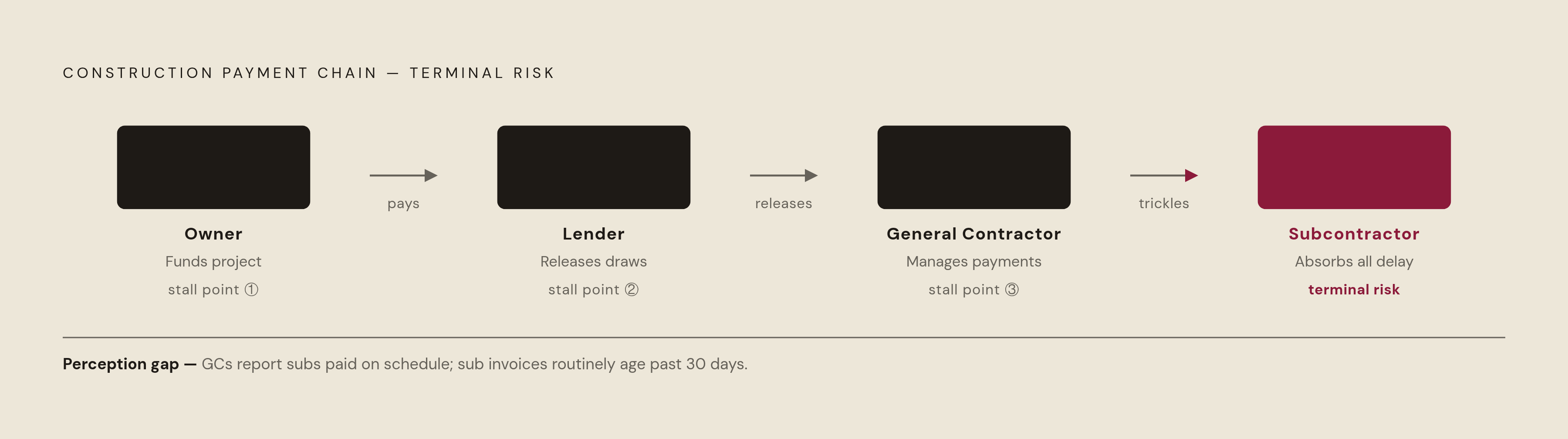
The reason subcontractors end up in that position so often traces back to where they sit in the payment chain. Money moves from owner to lender to GC to sub, and at every handoff in that sequence there's a chance it stalls or stops entirely, with the subcontractor absorbing the consequence at the far end. That structural exposure isn't incidental to the industry, it's chronic. Payment delays hit large shares of contractors and subcontractors on a regular basis, and slow payment costs the U.S. construction industry an amount estimated in the hundreds of billions of dollars a year.
Layered on top of that structural exposure is a perception gap that keeps the dysfunction running. Subcontractors report waiting substantially longer to get paid after submitting a pay application than general contractors believe they're waiting, a gap measured in weeks that sits at the center of most recurring payment disputes. GCs, in other words, often think the system is working roughly on schedule while the subs living inside it are watching invoices age past 30 days or more.
Filing a lien is the point where a subcontractor has decided the relationship, or at least the informal patience that holds it together, has broken down, partially or fully. That means the filing itself carries information about conditions that were already deteriorating before the date on the document. Everything that follows in this piece is about learning to read those conditions earlier, using the filing as confirmation rather than as the first data point.
The distress timeline before a lien appears
Corporate distress analysts have a framework for this that translates cleanly to job sites. When tracking a company heading toward insolvency, no single event, a missed debt payment, a going-concern warning, an advisor hire, tells the whole story on its own. What makes the signal meaningful is convergence: once different parts of a business and its capital structure start telling the same story, isolated events stop looking isolated. A forbearance agreement alone might mean nothing. A forbearance agreement alongside a workforce reduction, an asset sale, and creditor talks means something specific.
The same logic holds at the level of a single subcontractor on a single project. Long before a lien gets filed, a trail forms: pay applications age past the terms written into the contract, preliminary notices go unanswered by a conditional waiver, crew counts shrink without explanation, and material deliveries start arriving late or incomplete. None of these events, in isolation, confirms a subcontractor is in trouble. Contracts get renegotiated, crews rotate for reasons that have nothing to do with cash flow, suppliers have their own delays.
But when several of these signals appear on the same scope, in the same window of time, the pattern becomes unambiguous. A filed lien read alongside that upstream trail confirms a deterioration that was already underway. Waiting for the filing to act means acting weeks or months later than the first real signal appeared.
Where the national Lien Index misleads
The NCS Credit Lien Index is the most systematic national tracker of mechanic's lien filing activity, and it's genuinely useful for spotting macro trends in payment stress across the construction industry. It also has a structural flaw that trips up anyone reading it casually: its freshest quarterly reading is, by the mechanics of how the data gets collected, its lowest and least reliable one.
Readings above neutral signal elevated filing activity and rising payment stress; readings below neutral signal declining activity, which can mean fewer active projects, easing pressure, or simply a backlog at the recording offices that haven't caught up on entering filings yet. That last possibility is the trap. Because liens get filed later in a project's lifecycle and recording offices process them on their own schedule, a newly published quarter almost always understates real activity, and it gets revised upward as the backlog clears.
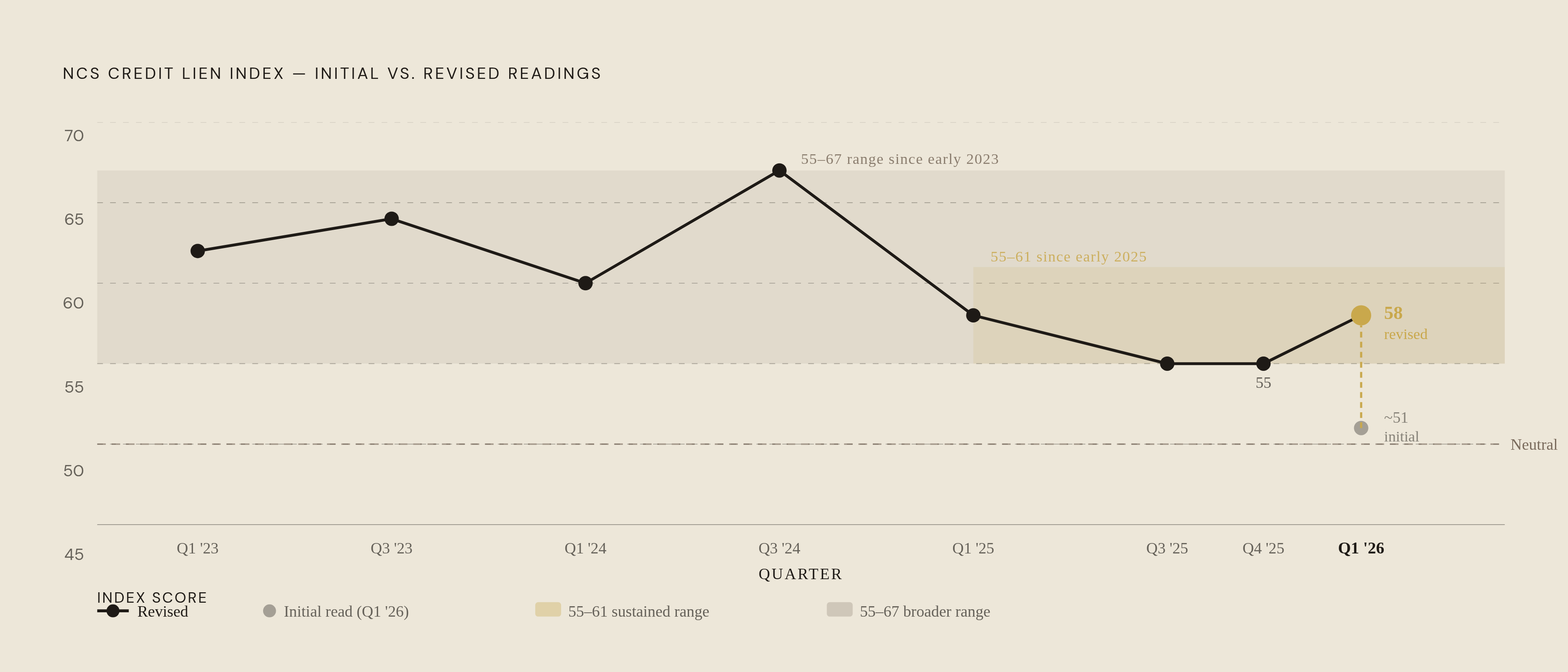
Q2 2026 offers the clearest demonstration of how badly that can distort a first read. Q1 2026 published initially at a reading just above neutral, which on its face looked like a decline from the prior quarter. Once recording offices caught up on their backlogs, that same Q1 number revised upward to 58, actually landing above Q4's own revised score of 55. NCS Credit has said outright that it expects Q2's initial reading to follow the same pattern and revise upward once the data settles.
Zoom out past any single quarter's noise: the fully revised Lien Index has held in a broadly elevated range of 55 to 61 since early 2025. That's a sustained stretch of elevated payment stress rather than a series of alternating good and bad quarters. An earlier data point extends the picture further back, with the index ranging from 55 to 67 since early 2023. Anyone reading a single freshly published quarter as evidence that project health is improving is, more often than not, reading filing-office lag rather than reality.
Regional detail adds texture without changing the underlying point. The West posted a below-neutral reading, down from a Q1 figure that had itself sat just above neutral once revised. Texas, Florida, California, Nevada, and Georgia remain the top states by lien filing volume, a ranking that's stayed fairly consistent and reflects where construction activity concentrates as much as where payment stress runs highest.
What pattern, timing, and concentration in filings reveal
A single lien filed on a project tells an analyst almost nothing on its own. Financially healthy subcontractors file liens routinely to protect their position on a disputed change order or unpaid retainage, and doing so is a normal, sometimes purely strategic, use of a legal right. The filings become diagnostic once they cluster, by trade, by timing, or by the size of the subs involved.
Checking timing relative to project phase reveals the most about a filing. Filings that appear at mobilization or in the middle of a project, instead of clustering at close-out where retainage disputes normally live, point to a payment problem upstream of the sub, most likely a GC cash-flow issue or a stalled owner draw. A retainage dispute at the end of a job is routine business. A cluster of filings six weeks into a scope is not.
Concentration by subcontractor size is the second thing to check. Small subcontractors absorb a disproportionate share of the financial pressure that late payment creates, given how thin their reserves run compared to larger firms. When the small subs on a project start filing while the larger ones stay quiet, the likely read is that the GC is triaging: protecting its most important relationships and letting the bottom of the payment chain absorb the squeeze first.
Trade clustering matters too, though it takes more judgment to interpret. Multiple filings from subcontractors within the same trade, electrical and mechanical scopes being common examples, on a single project suggest a scope-level problem: disputed change orders, gaps in the original scope definition, or one distressed subcontractor whose non-payment is dragging its own sub-tier down with it.
None of these signals settle the question by themselves. The distinction that actually matters is between a single, strategic lien filed by a solvent firm protecting its position on a disputed change order, and an accelerating cluster of small-sub filings in the third quarter of a project timeline. The second pattern is the one that signals real distress, and reading it correctly requires the context built in the earlier sections: pay-app aging, crew headcount, and waiver behavior all sharpen a call that a filing count alone can't make.
How lien waiver tracking fits into the monitoring workflow
Lien waivers get treated on most projects as paperwork, a box to check before releasing a payment. Tracked systematically, they function as a real-time monitor of payment health that can flag distress before a lien ever gets filed.
A standard payment cycle includes four waiver types, and each carries its own signal. A conditional progress waiver only becomes effective once payment clears, so its presence tells you payment is expected but not yet confirmed. An unconditional progress waiver becomes effective on signing regardless of whether payment has cleared, so it should only ever get issued after payment has actually gone through. A sub that signs one before payment clears is either under financial pressure severe enough to take the risk, or the paperwork process itself has broken down. A conditional final waiver applies at close-out, contingent on final payment clearing. An unconditional final waiver releases lien rights completely and should never be signed until final payment is confirmed in hand.
The monitoring signal sits in the gap between two events: a pay application has gone in, no conditional waiver has come back, and no lien has been filed yet. That gap is the window where a project team can still intervene before the relationship breaks down into a filing.
Poor waiver tracking creates exposure that goes beyond missing an early warning. An owner or GC who can't produce a clean waiver chain for completed scopes can end up paying twice, once to the subcontractor they believed was already paid, and again to whoever files a lien because the paper trail never confirmed it. State rules on what makes a waiver enforceable, and when it has to be collected, vary enough that a monitoring workflow built for one jurisdiction won't necessarily hold up in another. A national portfolio needs its waiver tracking built to account for that variation project by project.
What happens when a subcontractor hits the distress threshold
The damage that follows a subcontractor's slide into distress is rarely legal in nature first. It appears in the schedule, in crew availability, and in whether materials keep arriving on the dates a project plan assumes they will.
The sequence usually starts with the crew. Late payment pushes subcontractors to scale back headcount, cut hours, or pull off a job entirely, and once subs stop showing up, the projects that depend on their scope stall behind them. Nearly half of construction professionals report that late payments add one to two weeks to a project timeline, and a substantial share report delays of three to six weeks; only 15% say payment delays don't extend the schedule at all. Small subcontractors bear the worst of it: a large majority of professionals surveyed say small construction firms face more financial delay exposure than large firms operating on the same jobs.
The consequences don't stop at the schedule. They extend into who's willing to bid the next job. Every subcontractor surveyed by Rabbet in 2024 said it evaluates a general contractor's payment history before bidding, and a large majority reported having rejected a project outright over payment reliability concerns. A GC whose subs are filing liens is already being priced or excluded in future bid rounds, whether or not that GC realizes it. And the subs who do keep bidding build the risk into the number: contractors inflate their bids to protect against slow payment, a cost that flows to the owner and compounds across the project portfolio.
Underneath all of it is a simple cash reality. Most subcontractors are covering labor and materials out of pocket while they wait to get paid, and roughly one in three pull from personal or retirement savings to close the gap. That's a firm with thin reserves, not one absorbing a temporary shock with deep ones. That's a margin thin enough that one more delayed pay application can be the difference between finishing the scope and walking off it.
Why this hits energization-dependent projects hardest
Nowhere does a subcontractor pullback cost more than on a project where energization or commissioning is the delivery gate, because those schedules assume equipment arrives exactly when the installation sequence needs it, with no slack built in to absorb a mid-scope demobilization.
Equipment lead times are the reason the slack doesn't exist. Power transformers now carry average lead times of roughly 128 weeks, close to two and a half years, and generator step-up transformers run even longer, averaging around 144 weeks. Demand for certain transmission and distribution equipment has climbed as much as 274% since 2019, with generator step-up transformers seeing the steepest growth of any category. Switchgear, generators, and other long-lead items often have to be ordered months, sometimes years, before installation, and a missed procurement date creates a delay that becomes visible on site only much later.
Put those lead times next to a subcontractor demobilizing mid-scope after filing a lien on an electrical package: a transformer already on order arrives into a scope gap rather than a ready installation sequence. The equipment shows up. The crew that was supposed to install it doesn't.
The stakes are compounding for a specific reason: data center and power infrastructure work is currently the segment of construction most insulated from the broader billing slowdown, with contractor backlog in that sector running roughly three months ahead of non-data-center backlog as of May and June 2026. These are exactly the projects where energization readiness cannot slip, and where the two-year equipment order already placed makes a subcontractor's silent pullback the costliest version of the distress signal this piece has been tracking from the start.