Warehouse and Lay-Down Facility Selection for Project Supply Chains
Inadequate staging facilities can delay entire crews regardless of when materials arrive.
Critical materials can be ready when project crews are only if the chosen warehouse and lay-down facility can support them. Facilities must be evaluated against delivery routes, yard restrictions, phased procurement requirements, available power, and cost per square foot. For AI-integrated logistics, the same discipline applies because tools can expose timing and capacity mismatches only when the underlying staging process makes those constraints visible.
Why facility selection has become a schedule constraint, not a real-estate decision
Consider a project whose schedule has been declared achievable, but whose staging assumptions have never been tested. Procurement proceeds while storage is left for later. If a critical component then sits in an inadequate or inaccessible staging location, its availability does not translate into readiness for installation. That delay can push back the date when an entire crew mobilizes. The schedule depended on a material flow that the plan never established.
Long equipment lead times make it hard to make up for that delay. Switchgear lead times of 42–60 weeks and transformer lead times up to 52 weeks require procurement to begin before detailed facility planning is complete. Staging capacity therefore has to be secured in parallel with procurement, before purchase commitments have been made. Pre-positioned inventory becomes the buffer against delivery uncertainty, but only if the project has somewhere suitable to receive, protect, and release it.
The planning sequence has consequently changed its direction. Instead of locking the schedule and then finding storage, teams must establish where materials can be staged before treating installation dates as achievable. Facility selection belongs at the front of project planning because it governs whether early procurement can support the work.
What supply chain delays actually cost a project schedule, and where they originate
HKA’s CRUX Insight report, published in November 2025, found that on distressed projects the average sum in dispute represents roughly a third of the contract budget, while the average time claimed exceeds half of planned duration. Its sample covered major projects across more than a hundred countries. These figures measure disputes and do not show how much was lost because of warehouse decisions alone. They nevertheless establish the scale of exposure when project assumptions fail. A staging error needs to be part of that schedule-risk assessment as well as the storage budget.
Preparation is where those assumptions become commitments. Procurement timelines that do not reflect actual lead times can make a construction schedule look feasible before execution exposes the gap. Facility planning can compound that error when it assumes receiving space will be available whenever purchasing requires it.
Supplier readiness also differs from readiness to deliver. A supplier may have inventory available, yet materials remain stationary when transportation has not been coordinated. Warehouse capacity cannot resolve that mismatch by itself. The preparation phase must connect purchasing, transport, and staging so that each commitment supports the next, rather than leaving the project to discover their incompatibility when crews need the material.
Proximity and access configuration as the first filter in facility evaluation
First, ask whether the required delivery sequence can flow through the facility’s access configuration. Distance alone cannot answer that question. Road geometry, gate width, turning radius, and traffic patterns must work for the delivery vehicles the project needs and how often they arrive. The site logistics plan must include entry and exit points that suit the expected delivery volumes and the equipment needed. Where space is tight, one-way traffic patterns can help reduce congestion.
The route to the site requires the same scrutiny. Weight-limited bridges, low clearances, and permit-required haul routes can negate the apparent advantage of a nearby warehouse. Route analysis must therefore be part of facility evaluation rather than an assumption left to the transportation provider. When materials arrive by rail or intermodal, transloading capability is another access requirement. A facility without it adds another handling step, which takes time and raises the risk of damage before final delivery.
Access planning also governs the on-site and off-site split. Critical items needed right away belong on-site in secure containers, while bulk materials and future-phase supplies belong in protected off-site storage until they are needed. That allocation reduces handling costs and exposure to damage and theft. It must be encoded in the logistics plan, because it determines which materials travel through each access point and when.
Lay-down yard configuration — primary and ancillary storage and their siting constraints
Washington State’s EFSEC review of the Carriger Project documented a siting restriction that threatened construction feasibility. A mitigation measure required lay-down yards to be at least 2,500 feet from noise-sensitive receptors. All of the applicant’s planned yards, and most lands within the Project Lease Boundary, fell within that buffer. The applicant indicated that the lack of available yard locations challenged the feasibility of constructing the project. The constraint concerned whether the project could be built.
EFSEC resolved the issue by distinguishing primary from ancillary lay-down yards. Primary storage areas hold a significant share of project equipment and materials, generating more noise sources over longer periods and requiring a larger buffer. Ancillary yards require a smaller buffer. Classify each yard by its proportional share of total project inventory before committing to a location. The volume stored is the basis for distinguishing primary from ancillary storage.
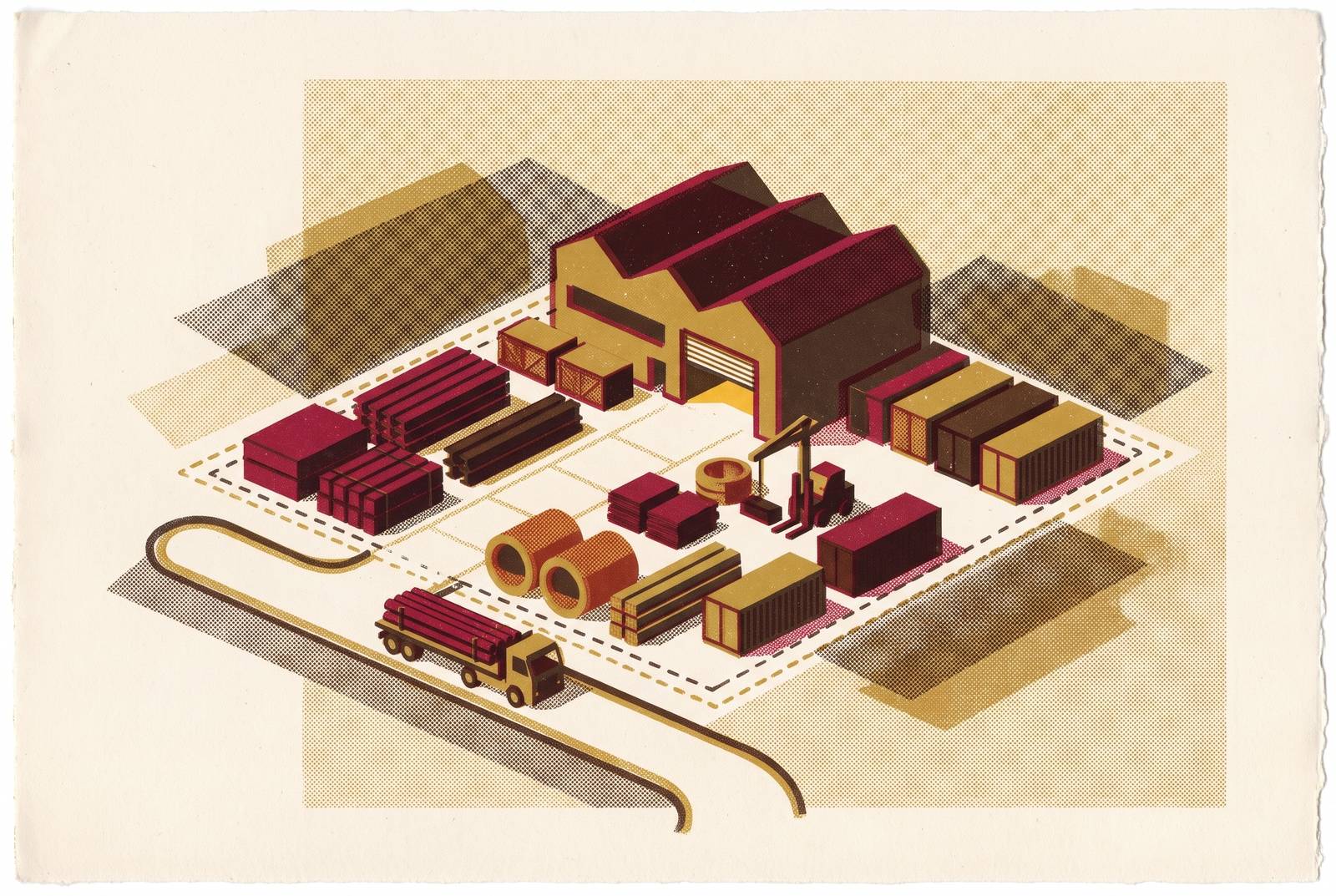
Physical layout imposes a separate set of limits. Scaled site drawings must show crane positioning, hoisting spots, and utility hookups because these limit where lay-down zones can go even when setbacks allow them. Within those zones, steel beams, pipe, precast components, and bulk aggregates should be organized by project phase and installation sequence to improve safety and reduce handling time. Warehouses serve a different role, buffering purchasing from job-site delivery through secure storage of early bulk shipments. Materials can then move to lay-down space or directly to the project without overloading the site or exposing stored inventory to weather and theft.
Phased staging capacity and the procurement calendar as matched constraints
A facility must have the right capacity at the right time in the project sequence. Total square footage is only a starting measurement. Early material commitment strategies require upfront capital well ahead of traditional procurement windows, but that purchasing decision also creates an early storage requirement. If the facility cannot take in those arrivals, the strategy fails even if orders were placed promptly. Capacity must be assessed as a time series.
Professional GCs recommend that at least 80% of long-lead items be physically accounted for and stored before demolition begins. The facility must also have receiving hours, dock availability, and handling equipment aligned with the procurement calendar. Space that is nominally free does not establish that the warehouse can receive materials when they arrive. Receiving capability is part of usable capacity.
Warehouse and field teams need to share inventory management systems so that releases follow conditions in the field as they change from the original estimates. Otherwise, early deliveries congest the site while late releases stall crews. Phase I, Phase II, and later-phase materials should also be stored and tracked separately so that accessing one phase does not disrupt another. This separation is a layout requirement as well as an inventory practice, because phased access must be physically possible.
Power availability, automation readiness, and the emerging infrastructure requirements for modern staging facilities
Power availability becomes a primary selection constraint when a facility must support robotics and AI-integrated logistics systems. Nominal electrical capacity is not enough by itself. The evaluation must establish whether permitted, available capacity can support the material handling equipment the project requires on the dates it is needed. Occupiers specifying new facilities are also requiring automation-ready layouts and higher clear heights. A facility that cannot support that infrastructure may need costly retrofitting or limit how it can be used in the future.
Southern California Edison’s 2025 biannual energization report to the California Public Utilities Commission found delays in the procurement of switches, transformers, and cables that were outside the utility’s control. It also identified lengthy permitting by multiple authorities-having-jurisdiction as an energization obstacle. These constraints extend beyond the warehouse building itself. A facility can therefore show sufficient capacity on paper without having that capacity available on the project schedule.
For teams evaluating modern staging facilities, the practical response is to add power availability to the selection criteria and assess it against the energization timeline. Automation readiness must be judged against the intended operation. This keeps the technology decision tied to the material flow it is meant to support. AI-integrated workflows cannot make up for handling infrastructure that lacks the power to run when procurement arrivals begin.
What field conditions reveal that declared facility plans conceal
A declared facility plan requires the same field validation as a P6 schedule. Documents alone do not establish current operating conditions. A lay-down yard that was available during planning may be committed, constrained, or inaccessible by the time work begins. The appropriate verification is to walk the site and record what is complete, blocked, or unavailable.
Supplier inventory and warehouse capacity may both appear satisfactory while the transportation arrangements between them remain misaligned. Walking the path materials take tests the handoffs that separate plans can hide. The purpose is to confirm that a warehouse or yard exists and that the procurement sequence can pass through it under current conditions.
Quality control checkpoints when materials reach the warehouse and the site provide more chances to check conditions in the field. They belong in the logistics plan as operating controls. As procurement advances and site conditions evolve, facility availability and staging arrangements must be revalidated rather than inherited unchanged from project initiation. A sound initial plan can become stale before mobilization. Verification must therefore continue through the sequence in which materials are received, held, and released.
Rebuilding the facility selection process around schedule consequences rather than cost per square foot
The procurement calendar must become the controlling document for facility selection. Teams must first check access configuration and carry out route analysis against what the delivery vehicles need. Yard classification and regulatory siting restrictions must then be resolved before location commitment, while phased capacity is matched to the calendar’s changing storage and receiving demands. Power availability must be assessed against energization dates, followed by field validation as procurement advances.
This changes when facility commitments are made. Early procurement requires staging capacity to be secured on the same schedule as the purchasing commitment, with the on-site and off-site allocation defined from the start. Selecting inexpensive space first and reconciling it to the delivery sequence later leaves the central operating assumptions untested. Adding automation at that point risks accelerating a process whose physical constraints remain unresolved.
AI-integrated logistics workflows can surface mismatches between procurement timing, facility capacity, and field readiness, but only when the process makes those signals visible. BCG’s 2026 analysis of AI agents in supply chains describes logistics responses that assess partial shipments and production resequencing at the same time after a delivery fails, then rank the scenarios within an hour. That response speed depends on a staging plan structured well enough to expose workable options. It is not evidence of a facility deployment timeline, nor does it remove the need for field validation.
Start with the process most likely to break. For asset-heavy construction and logistics projects, the interface between procurement commitments and staging capacity is the critical candidate for an audit of actual material flow before the schedule is baselined. That audit moves unresolved facility assumptions into planning, where they can change the commitment. Without it, teams leave the field to reveal that the space they selected cannot support the schedule they approved.