Self-Deploying AI Operations on a Job Site Using Existing Dispatch and Delivery Data
AI agents can deploy in weeks by connecting to existing dispatch and delivery data.
Self-deploying AI operations on a job site begin with existing dispatch and delivery data. An agent can start work within weeks when live feeds link to an authoritative schedule, work packages it can identify, and clear gates where people review its work. Process connectivity is the barrier. Fast deployment therefore means redesigning one operational workflow so the agent can read current conditions and act within agreed limits.
Why job sites are already producing the data an AI agent needs
Most discussions about AI on job sites frame the problem as data scarcity. The operational record tells a different story. Active sites already generate dispatch records, delivery confirmations, timecards, plant hours, RFIs, submittals, and weather events. These signals are in project management platforms, telematics feeds, and field reports because they come from everyday site work. Their usefulness does not depend on whether anyone originally collected them for AI.
A late submittal may appear manageable until it coincides with rising out-of-sequence work. Delivery slippage becomes a scheduling risk when compared with committed windows and the activities waiting on that material. An ageing RFI can likewise reveal that a decision is approaching the point where it can no longer protect the critical path. These relationships can be visible before the resulting damage appears in a KPI dashboard.
The missing capability is a connection between records and decisions. A delivery confirmation establishes what arrived, while the schedule establishes what that arrival permits crews to do next. Deployment readiness therefore depends on making those relationships readable to an agent, rather than first installing sensors or building a data warehouse.
What an AI agent actually does with dispatch and delivery signals
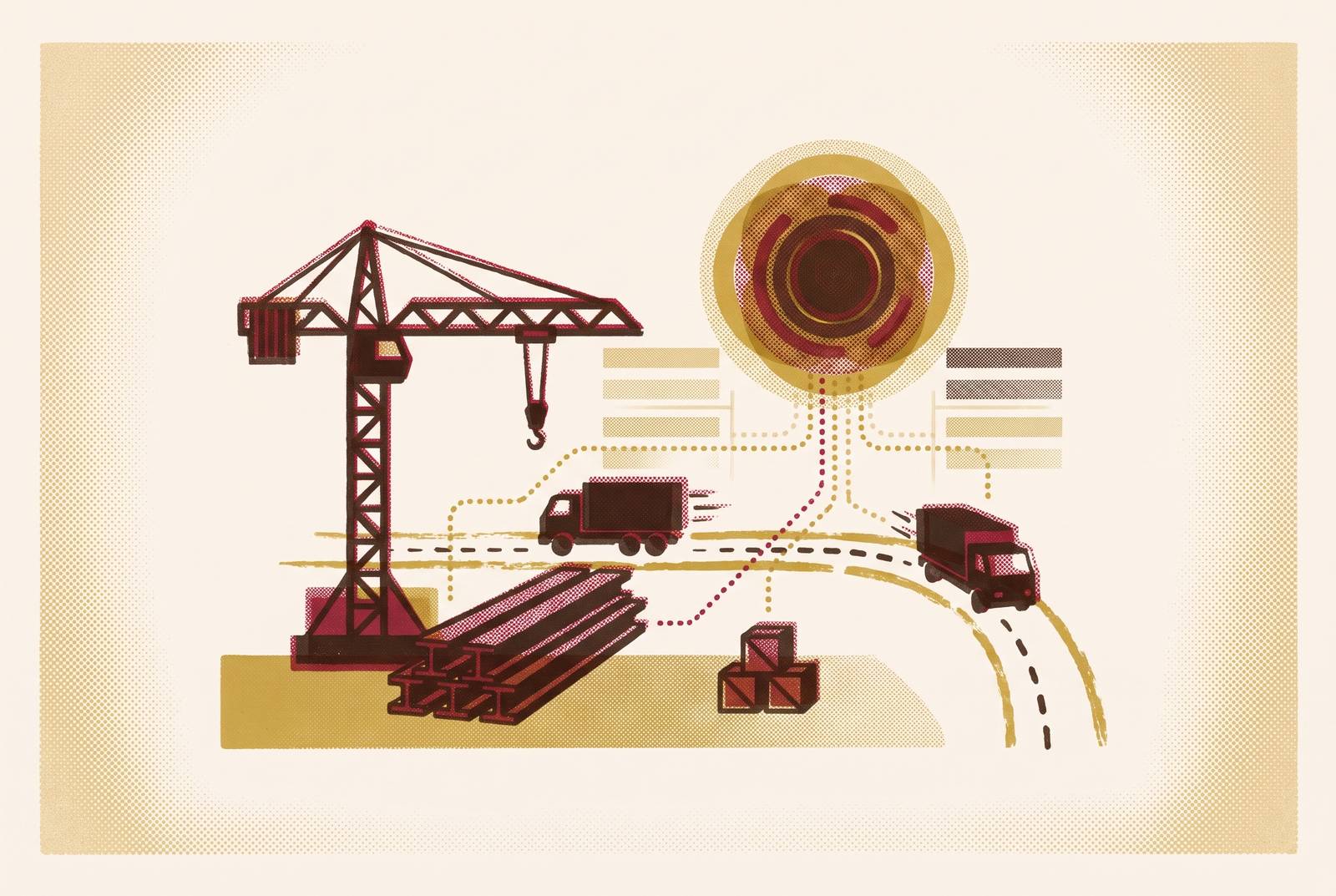
An agent uses dispatch and delivery data to execute a decision loop. The loop can be understood in roughly five phases, including intake, planning, decision, execution, and learning. These phases describe functional roles. Together, they explain how an incoming update becomes an assignment or a proposed change to the sequence of work.
Intake parses a delivery update or work order into structured fields. Planning then brings in the current field state, including open tasks, crew availability, vehicle telematics, weather, and material status. The decision phase scores possible responses against sequence constraints, SLA windows, and resource utilization. Execution pushes the assignment or resequencing instruction and books dependent actions. Learning compares the outcome with the decision and updates the scoring model.
A material delay makes the mechanism concrete. The delivery update changes material availability, which the agent reads against scheduled activities and their dependencies. It then presents resequencing options, resource impacts, and downstream effects rather than leaving a coordinator to discover each connection. Oracle’s 2026 construction model places the GC at this decision point, validating options against field realities and implementing the preferred path. Automated monitoring tracks routine progress, identifies risks, and detects deviations, while the GC coordinates trades and handles exceptions.
Learning gives this operating loop its adaptive quality. The agent changes its policy based on outcomes instead of waiting for a data scientist to retrain it. Over time, that feedback can improve its scoring of the site’s delivery patterns, crew compositions, and sequence sensitivities. Self-deployment in this sense does not remove operational judgment or the need for initial connections.
Why the barrier is process connectivity, not data volume
Many deployments stop at dashboards because the underlying processes cannot support a live decision loop. Data arrives late, uses codes that do not match, or is stored in systems the agent cannot query. Accuracy is part of the problem, but only part. A stale crew matrix or outdated delivery-time estimate can produce precise but misleading recommendations even when the software works as designed.
Dispatch may sit in one system, delivery confirmations in another, and the scheduling record in a third. An agent with access only to dispatch can read a changed departure without knowing which committed activity is exposed. Access to the schedule alone leaves it unable to distinguish a plan from current material availability. More records in either system do not repair the missing relationship.
For implementation, this changes what counts as deployment work. Standardizing codes, aligning timestamps, and connecting systems through APIs are not preliminary housekeeping before the useful work begins. They make the decision loop possible in the first place. Without those links, the agent cannot form a coherent picture of the site or translate a changed delivery condition into a relevant operational response.
How do you deploy job site AI without a lengthy implementation?
A queryable, authoritative scheduling record is the first condition. Multiple competing versions of P6, or a schedule available only as a PDF export, leave the agent without a dependable reference for committed dates. It also needs to know which predecessor tasks gate successor tasks. Otherwise, a delivery slip with available float can look like a critical-path threat, while a genuine constraint may go unrecognized.
Timestamps tied to specific work packages or cost codes let the agent identify both when something changed and which activity it affects. Free-text records that require a coordinator to interpret the affected task interrupt that connection. The easiest fix is usually to link existing confirmation emails, telematics pings, and dispatch logs to work packages. Clean RFI and submittal open/close timestamps, linked to the schedule, then let the agent detect an approval delay before it blocks a delivery window.
Human review is another condition. Datagrid’s construction AI report says people still need to review safety-critical outputs, especially in the early weeks when validation rules produce false positives and need tuning. Financial and contractual outputs likewise need a hard sign-off rule. Someone accountable must review pay applications, bid figures, and forecast changes from the agent before they go to a client or into a contract. This preserves the audit trail while the site team builds trust through validated recommendations.
One painful process, such as delivery coordination, RFI throughput, or 30-day delay risk, provides a practical starting point in a bounded workflow where late visibility already has a cost. Connecting that workflow is faster than completing a full data governance program before anything runs. The selection also gives the team a concrete process to redesign, rather than an abstract platform strategy to implement.
Why connecting data to an agent requires redesigning the process, not automating it
Even when the starting point is narrow, a broken workflow still needs to be fixed. An agent connected to inconsistent coding, fragmented approvals, or decisions made outside the system executes those weaknesses faster and with greater confidence. The process must generate a timely account of the work the agent is expected to coordinate.
The electrification parallel explains the distinction between substitution and redesign. Early factories that switched from steam power to electric motors but kept radial layouts around a central power source saw almost no gain in how much they could produce. Firms that reorganized their floor plans around distributed power gained far more. The construction equivalent is connecting an agent to a delivery log still updated manually two days after the event. The same problem occurs when close dates are added to an RFI register only as pay applications are being prepared.
If the agent is to respond to live deliveries, the process must establish who records the change, where it is entered, and how quickly it becomes available. Oracle’s model shows schedules becoming living plans that change with the weather, the status of equipment, deliveries, and which crews are available. That change requires current inputs. A plan cannot adapt to a field event that has not reached the system.
A process audit begins with the site team walking through how a delivery is logged, where the record goes, who reads it, and how long it takes to affect a scheduling decision. That account identifies steps that can disappear, entries that need to happen as events occur, and approvals the agent can handle within its authority. Technology purchasing alone leaves these operating choices unresolved, while process redesign makes them explicit.
Where self-deploying agents are producing operational results on active sites today
Oracle’s 2026 construction analysis provides a specific example of existing data acquiring a wider operational role. It describes vision systems and sensor data used to detect PPE violations and restricted-zone entries also exposing workflow friction, sequence conflicts, and emerging quality issues. These signals also have operational uses. The example supports the central mechanism of reusing an existing feed to inform scheduling decisions without first creating a separate collection effort.
Oracle’s model also distinguishes automated analysis from site leadership. It assigns routine progress tracking, risk identification, and deviation detection to automated monitoring, while describing the GC’s highest-value work as orchestration. That division gives a concrete account of what changes operationally. The system surfaces a deviation and its implications, and the GC coordinates the adjustment against field conditions. It does not establish that every consequential scheduling decision is already autonomous.
Datagrid’s report adds an important qualification about deployment maturity. Its discussion of early false positives and validation-rule tuning describes the work required while construction AI enters operational use. Human review remains part of that model. The evidence supports targeted deployment and supervised decisions.
Oracle describes operational reuse of existing signals, while Datagrid identifies the validation conditions needed to use outputs responsibly. Neither establishes a platform-wide guarantee of deployment in under 60 days. Fast-cycle deployment is defensible for specific workflows with accessible records and defined decision authority.
The failure modes that prevent self-deployment from taking hold after go-live
After go-live, three predictable failures can prevent the operating loop from taking hold. They are dirty data, alert fatigue, and site-team rejection. Each begins in the process surrounding the agent. Looking at each failure on its own makes it easier to see what to fix than blaming poor results on AI as a whole.
Dirty data leads the agent to make confident decisions based on a false picture. An incorrect asset hierarchy, stale skill or crew matrix, or delivery estimate based on outdated averages can misdirect the agent’s scoring. The site team quickly loses trust when it sees someone act on a wrong recommendation. The remedy is not a single cleanup before launch. People must enter accurate records on time as part of their everyday work so the upstream record stays usable as conditions change.
Alert fatigue sets in when supervisors get more outputs than they can assess or when those outputs give no reasons. A flag without supporting records asks an experienced foreman to accept a conclusion on faith. Repeated overrides without consequence then signal to the wider team that the system is optional. Calibration should produce a small set of high-confidence flags with traceable reasoning. Source records, submittal dates, and RFI ageing timestamps let supervisors verify why the agent has raised an exception.
Site-team rejection is a distinct problem of authority and judgment. An agent that contradicts experienced judgment without explanation will be bypassed even when its connections function correctly. An operating model that lasts gives supervisors exception queues and frees them from carrying out every routine assignment. The agent handles high-frequency, structured decisions, while experienced people retain edge cases, stakeholder coordination, and contractual judgment. Better information arrives earlier without pretending that field experience is dispensable.
Gartner forecasts that a large share of agentic AI projects will be cancelled by the end of 2027 because of escalating costs, unclear business value, or inadequate risk controls. That forecast strengthens the case for a specific first deliverable with measurable value and data conditions already close to being met. It is not a reason to postpone fixing a known workflow. Experienced operations teams can diagnose the handoffs, delays, and missing accountability that prevent deployment from holding. Successful deployment depends on the agent reading a live, accurate operational picture rather than a reconstructed record of what happened last week.