AI Agent Applications in Construction Logistics Coordination
AI agents can close the gap between knowing and doing in construction coordination.
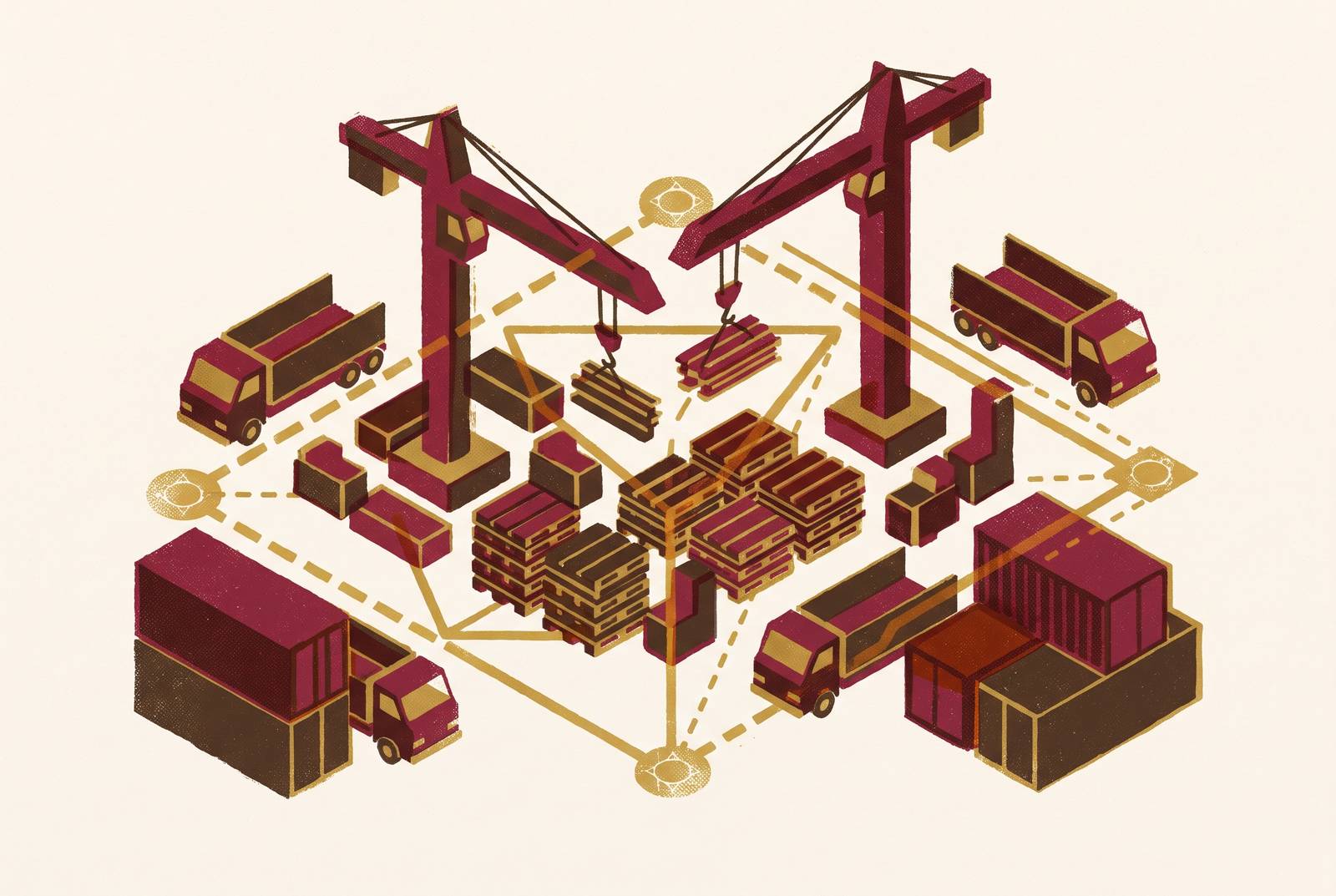
AI agent applications in construction logistics coordination are most useful when they turn shared information into completed follow-through. Fast-cycle deployment starts with a process audit and one well-understood workflow, supported by validated data, bidirectional integration, and human oversight. This process-first route to deployment leaves delivery of working site operations in under 60 days unproven for any platform.
Why construction logistics coordination keeps failing despite better software
Construction has more software than ever, yet coordination still fails between systems and teams. Centralized information has not removed the need for someone to advance the work. Platforms such as Procore and Autodesk provide shared records, but recording a changed status is different from completing the next coordination step. The structural weakness is the handoff between knowing and doing, where a visible requirement still waits for a human trigger.
That handoff consumes time even when the underlying decision is straightforward. Project managers lose hours of their week to RFI tracking, submittal coordination, meeting action tracking, and status reporting. Much of this is administrative follow-through. An approval may be in place, for example, while the fabricator still waits for the notification that lets it proceed.
If the missing work is a follow-up, reconciliation, or notification, another reporting layer leaves the execution burden with the same people. Information must cross an organizational boundary and cause the next appropriate action, often when no single person owns the full chain. That is the specific gap agents are intended to address.
What an AI agent actually does that a dashboard or workflow tool cannot
An AI agent pursues a goal across multiple steps, adapts when conditions change, and acts without a person triggering every move. A dashboard shows information that someone has to interpret. Traditional automation executes fixed rules, but its reach is limited by the conditions anticipated when those rules were written. An agent instead interprets signals from multiple systems and adjusts its next action to the current state of the work.
An RFI workflow makes that distinction concrete. The work includes checking approval status, sending timed follow-ups, and notifying the fabricator when approval arrives. A dashboard can expose an outstanding response, while a fixed workflow can issue a predetermined reminder. The agent carries the work through those steps and chooses its next move based on the status it finds. That does not give it authority to resolve the technical question inside the RFI.
Reliable coordination also requires more than agentic reasoning. Deterministic AI validates the data on which actions depend, while multi-agent validation frameworks let separate agents cross-check outputs before errors propagate downstream. Validation checks the basis for action, agentic AI manages the order of the steps, and cross-checking tests the output they produce. None makes human judgment unnecessary.
The potential advantage is the scope of coordination. A human coordinator often optimizes for the task immediately in front of them, while an agent can consider signals across the wider network simultaneously. That broader scope offers a way to challenge the traditional tradeoff between coordination cost and speed. That capability depends on the data and system access available to the agent.
The specific logistics coordination tasks where agents close the execution gap
Agents fit work that is high-volume, time-sensitive, and rule-followable in structure, especially when ownership of follow-through is fragmented. Submittal and RFI chasing meet those conditions. Monitoring approvals, sending timed follow-ups, and notifying fabricators are execution mechanics that can otherwise remain incomplete for days. The agent handles the sequence, while people retain decisions that depend on technical judgment, relationships, or knowledge of the site.
Traditional scheduling updates happen monthly at best, while weekly updates are recommended but often unachieved because a human scheduler must gather and compile the inputs. Agents can collect progress data from multiple sources, reconcile it, and surface conflicts before they harden. The work shifts from collection toward assessment. A surfaced conflict still needs human judgment when the available records do not capture the conditions that determine the right response.
Procurement coordination presents a related timing problem. Supplier risk signals, lead times, and programme dates must be considered together if procurement actions are to happen when thresholds are crossed. Supplier risk monitoring and demand forecasting are identified production use cases in logistics agent analysis. Their relevance to construction is the connection between an external supply condition and an internal requirement. Monitoring alone does not complete that connection unless the workflow also advances the appropriate procurement step.
Agents can reroute shipments when congestion or delays are detected, adjust delivery priorities, and update site teams. Freight applications establish the underlying coordination logic. Applying it to just-in-time material sequencing on constrained construction sites, however, requires attention to site-specific conditions rather than an assumption that freight performance transfers unchanged. Autonomy is limited to the execution mechanics.
Exception escalation ties these applications together. A well-designed agent escalates decisions requiring human judgment with the relevant context already assembled, instead of flooding supervisors with undifferentiated alerts. Teams can then handle more exceptions without coordination overhead growing at the same rate. People still have to make judgment calls and manage relationships. The agent reduces the work needed to bring an exception to the person capable of resolving it.
Why agents that look functional in demos routinely fail to reach production
A functional demonstration does not establish readiness for production. Across enterprises, some agents never reach production scale because the conditions they work in do not support dependable execution. In construction logistics, an agent encounters fragmented records, changing schedules, and decisions whose implications extend beyond a single tool. Showing that it can complete a sequence does not show that it can complete the right sequence reliably under those conditions.
Data quality is the most consistent failure point. Inconsistent, fragmented, or stale inputs can make an agent produce errors faster. Downstream reasoning cannot be relied on to repair a false premise introduced when a record enters the process. This is especially consequential when the agent has permission to act. An incorrect input is no longer confined to a report that a person may question before proceeding.
Some failures emerge only after the workflow is running. Semantic drift occurs when an agent continues quoting stale context after the underlying record changes, such as a submittal status updated in one system but not reflected in its working knowledge. Tool-sequence errors create a different risk. An agent might confirm material availability before checking the current delivery schedule, completing recognizable tasks in an unsuitable order. Silent degradation is harder to spot because the output gets worse while the error logs show no errors.
Governance based only on a pre-deployment checklist does not address these operating risks. The 2026 Singapore Consensus on Global AI Safety Research Priorities identifies auditability, validated deployment, runtime assurance, and human oversight as distinct principles. Its treatment of control and monitoring makes supervision an ongoing responsibility. Paper compliance is not operational safety. A workflow needs scrutiny after deployment, when changing conditions can expose weaknesses that a demonstration did not.
AI is strong at breadth and pattern recognition but weak on rare, high-stakes exceptions. A schedule optimizer can sound certain while overlooking a site condition known only to a veteran superintendent. The mistake is assigning it a decision that depends on knowledge it does not hold. More autonomy is therefore not, by itself, evidence of a better deployment.
How do you deploy AI operations tools in construction without a years-long IT project?
An operations team should begin with a process audit to establish exactly where coordination breaks and what the process looks like today before deciding which agent to deploy. That assessment separates workflows ready for automation from those that need rebuilding. Scope discipline follows from it. Starting with one painful process that the team knows well avoids the pattern of deploying too broadly with inconsistent data and too little understanding of how hard integration will be.
Data integrity must be established at the entry point. Deterministic validation needs to catch errors before an agentic process touches the record, so IT is not left to fix intake quality later. If unreliable records enter the workflow, more capable reasoning does not make the foundation dependable. Validation is part of operational preparation before autonomy is enabled.
Process standardization provides the next condition. The construction.live maturity model places the start of AI readiness at Level 3, where approval chains are defined and routing is standardized. Deploying an agent on a Level 2 process automates the chaos. The sequence is therefore consequential. An agent cannot compensate for unresolved ownership simply by moving work more quickly through an unclear approval chain.
To complete coordination spanning the ERP, TMS, WMS, and scheduling tool, the agent needs integration that supports reading and writing across the relevant systems. Otherwise, the deployment risks creating another silo. Pre-built connectors and bidirectional sync architecture are practical evaluation criteria because they address whether information and actions can cross those boundaries. A platform’s marketing cannot prove that it supports a given handoff.
These conditions also define a credible fast-cycle approach. A narrow initial scope must retain the validation, integration, and supervision that make execution dependable. The notes provide no basis for naming a platform that guarantees working construction logistics workflows in under 60 days. A process-audit-first operations approach is more defensible than a calendar promise because it identifies what can be deployed and what must first change. Speed depends on the workflow’s readiness.
What the Suffolk and MIT research suggests about where the real gains live — and what it cannot tell you
Suffolk and MIT’s joint white paper, “Construction in the Age of AI,” provides substantial field-grounded evidence for the opportunity, but its structure requires careful reading. The paper came out on September 16, 2026, and studied a San Francisco multifamily development finished between 2021 and 2024. The white paper drew on academic literature, case studies, expert interviews, survey input, and an industry roundtable involving more than 50 industry leaders. Its evidence base is broader than a demonstration. Its modeled outcomes still apply to one sample project.
The study identifies six priority domains with the greatest near-term AI potential, including design automation, offsite manufacturing, permitting, scheduling, skilled labor and subcontracting, and supply chain and procurement. Five of the six concern decisions made above the subcontractor level. That distribution shapes who can initiate change. The central argument is that meaningful gains require multiple workflows to change together, rather than another tool being attached to an otherwise unchanged process.
The savings model applies all six levers simultaneously to one sample project under one set of assumptions. Those results also cannot be credited to a single logistics agent or a workflow on its own.
The distribution of benefits is equally important. For the productivity gains modeled at the GC level to reach specialty trade contractors, downstream workflow integration may be needed. A better decision above the subcontractor level still leaves coordination work to be done below it. Agent logic must extend through the relevant coordination chain if its benefits are to reach the teams whose work depends on the decision.
This does not contradict starting with one bounded process. Initial scope discipline addresses deployment risk, while the study’s broader argument addresses how gains accumulate across connected workflows. The Suffolk and MIT evidence supports the opportunity for meaningful improvement, but capturing it depends on rebuilding the processes through which information becomes action, rather than waiting for agents to deliver modeled savings inside unchanged operations.