Single-Source Supplier Risk in Industrial Construction
Decades-old supply chains collapse when a single source fails.
Industrial construction supply chains were built for a world that no longer exists. For decades, just-in-time delivery and single-source sourcing were the rational, cost-minimizing choice: carrying less inventory, qualifying fewer vendors, and locking in one supplier per component kept bids competitive and margins intact when ocean freight was cheap, tariffs were low, and politics stayed out of procurement. That arrangement worked as long as every link in the chain held. It stops working the moment any single link does, and the same design that minimized cost in stable years now maximizes exposure in unstable ones. Geopolitical tension, tariff shocks, and logistics volatility are no longer occasional interruptions; they are the baseline condition procurement teams now plan around. Aluminum prices surged substantially in 2025, and steel followed, both driven by tariffs and constrained supply, pushing those increases straight into equipment costs, bid pricing, and project budgets. About 70% of contractors report being affected by tariffs already, and forecasting costs, securing materials, and holding a timeline together have become industry-wide struggles. None of this is a failure of individual procurement teams. It is the predictable output of a system engineered for cost efficiency in conditions that have already changed underneath it.
What single-source dependency means inside a construction project
Single-source dependency doesn't just mean a project buys a component from one vendor. It means a project has no pre-qualified alternative for something sitting on the critical path, so any disruption to that one supplier becomes a project disruption with no buffer to absorb it. That distinction changes where the real risk sits. Most supply chain maps in construction stop at tier-1 suppliers, the companies holding the direct contract, and they never extend further back. Tier-2 and tier-3 dependencies, the raw materials and sub-components feeding those tier-1 suppliers, go unmapped and unmonitored. A manufacturer can deliver a finished industrial part reliably for years, right up until a disruption two or three tiers upstream, in a raw material or a specialized input, halts that manufacturer's ability to price, produce, or ship on schedule. A project team can believe it has a healthy, well-managed vendor relationship while carrying an invisible single-source dependency two tiers back in the chain, with no warning until the delivery date slips.
Construction is more exposed to this than manufacturing or retail, and the reasons are structural. Demand is project-based, not repeatable: each job brings new specifications, new participants, and new constraints, so the volume and standardization that let other industries negotiate leverage against supplier risk simply isn't there. Many construction inputs are also high-value, low-volume, and technically specified, which narrows supplier options by design and makes qualifying a substitute a process measured in months, not days. Layer on multi-tier subcontracting, where the real supply network extends well past the names on the direct contract, and visibility gaps delay detection even further. A problem that only becomes visible to the project team at delivery has already closed the window for an orderly recovery.
How single-source risk cascades into schedule and cost
A single-source failure never stays inside procurement. It moves immediately into schedule sequencing, labor utilization, and cost exposure across every trade that depends on the delayed item. The mechanism is straightforward and brutal: a delayed critical-path component holds up every downstream activity tied to its installation, so crews, cranes, and inspectors scheduled around that delivery date sit idle. Sequencing dependencies then compound the damage. Fabricated steel has to be on site the day long-lead equipment arrives; if enclosures or support structures aren't ready when the main equipment lands, the delay doesn't just persist, it extends by however long it takes to catch the dependent work back up.
A peer-reviewed study found statistically significant increases in the expected financial impact of lead time and delivery delays, and a significant increase in the expected scheduling impact tied to supply chain reliability. Those findings line up with what practitioners already describe: schedules stretched past their planned limits, contract penalties triggered, and vendor delays becoming systemic. U.S. contractors are already absorbing real costs from these constraints, and a majority of surveyed firms report moderate or substantial cost increases tied directly to supply chain disruption. For large enterprises, the average cost of a major supply chain disruption runs around $184 million per event, a number that makes the cost of building redundancy into procurement ahead of time look small by comparison.
Most executives believe their supply chains are resilient. Only a small fraction have a resilience strategy that has actually been tested against a real scenario. That gap between stated confidence and demonstrated capacity is where you pay the cost above.
Transformers and electrical equipment as the sharpest live case
Power and substation transformers turn single-source dependency into an existential constraint on project delivery, not a mere procurement inconvenience. Once a transformer order falls behind on lead time, no workaround remains to recover it.
The constraint starts at the raw material. Just one domestic producer manufactures the grain-oriented electrical steel that transformers require. transformer supply carries zero redundancy at the material input level. A disruption at that single producer does not get absorbed by a competitor, because there isn't one. The U.S. also imports the large majority of its large power transformers, a dependency that cannot be unwound inside any individual project's planning horizon, no matter how early or aggressively a procurement team moves. U.S. transformer demand is projected to exceed domestic manufacturing capacity by a wide margin well into the 2030s, and building a new transformer manufacturing plant takes years on its own, before accounting for the shortage of specialized equipment and trained labor needed to run it.
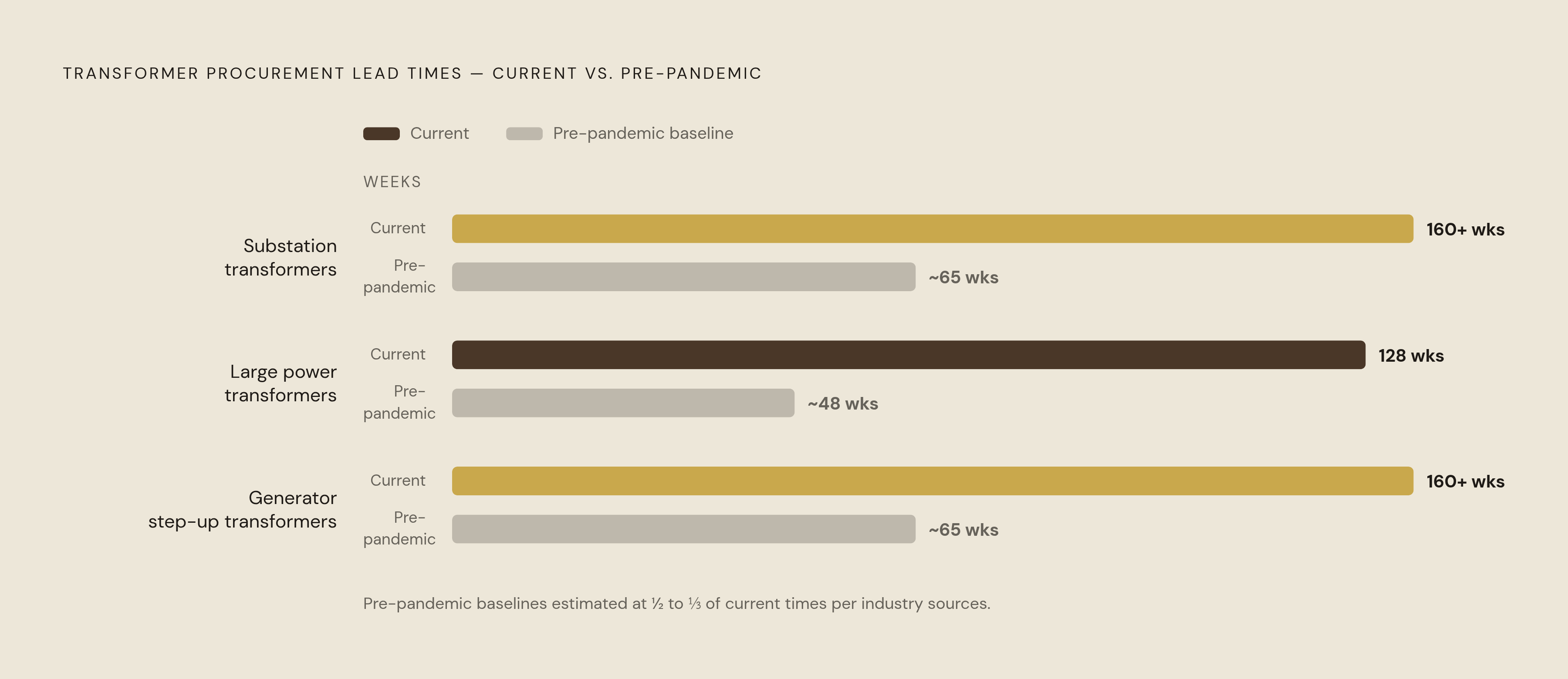
The consequence on live projects is already measurable. Substation transformer lead times now exceed 160 weeks. Large power transformers average 128 weeks. Generator step-up transformers run past 160 weeks as well. Those numbers run roughly two to three times pre-pandemic norms across the major equipment categories that industrial projects depend on to energize. At the panel discussion covered by CCIM in fall 2025, Daryl Luter, president at Fulcrum Associates in New Hampshire, described projects once delayed by design or financing hurdles now getting stuck behind transformers, switchgear, and copper components with year-long lead times. That account matches the data precisely: EPC firms are redesigning schedules, reordering work sequences, and locking in equipment earlier than ever, because access to scarce grid components now determines which projects move forward and which sit in multi-year limbo.
The federal government has treated this as a structural problem. The Defense Production Act has been activated for transformers, and federal incentives have been deployed to spur domestic production, a level of intervention that does not happen in response to a temporary blip. This is not confined to data centers or any single building type. Any industrial project where energization is on the critical path, from manufacturing plants to utility-scale infrastructure to warehousing with heavy electrical loads, now carries this exposure.
How the energization bottleneck rewrites the project schedule
The traditional order of industrial construction work, design, permit, build, then procure and commission, has effectively inverted. Procurement now sets the project timeline, and construction activity fills in around it.
That inversion is already visible at scale. A project team can permit a site, pour a slab, and raise a shell structure in well under a year, and then wait years for utility interconnection and the equipment that actually makes the building operational. Finished structures sit unenergized because the equipment needed to bring them online hasn't arrived, producing a growing stock of what amounts to dark capacity that no amount of additional budget or urgency moves up.
The commissioning window is the single most time-sensitive, least forgiving point in this sequence. Commissioning is often tied to regulatory approvals, grid agreements, or specific contractual milestones, so missing that window usually means restarting a process that takes additional months, not simply rescheduling a crew. Sequencing failures make this worse: equipment that shows up without its supporting infrastructure in place turns an already long wait into a longer one, and the specialized crews and inspectors who were lined up around the original date cannot be held in reserve indefinitely. Construction firms are also contending with a shrinking pool of financially stable suppliers in critical equipment categories, which narrows the field of options at exactly the moment lead times are stretching further. Even teams that see the problem coming early have fewer places to turn.
If procurement now governs the schedule rather than following it, the processes that support procurement, planning, and project controls have to be rebuilt around that reality. What that actually requires is the next question.
Why diversification alone does not resolve structural single-source dependency
The standard answer to single-source risk is to diversify suppliers, and in many material categories that answer is correct. It is also incomplete, and in the categories that matter most, it is not available on any timeline that helps a project already underway.
Diversification carries real costs even where it's possible. Stronger, more varied vendor relationships do improve reliability for long-lead and specialized materials, but building those relationships brings its own friction: inconsistent quality control, longer onboarding, and communication that fragments across more parties. Qualifying a new supplier in a technically specified category takes months under good conditions, a timeline that doesn't match the pace at which a live disruption actually unfolds.
For the most constrained categories, large power transformers and the electrical steel that feeds them, diversification runs into a structural wall. With a single domestic producer of grain-oriented electrical steel and heavy reliance on imports for large power transformers, the domestic supply base simply cannot scale up quickly, regardless of how much capital or procurement intent a project team brings to the problem. In these categories, diversification without expanding the supply base itself just relocates the dependency. A project with two transformer suppliers can still find both of them drawing from the same constrained material input. That creates the appearance of redundancy without the substance of it.
Most resilience plans have never been tested against a real scenario. A plan needs to be stress-tested against specific events, supplier insolvency, a port closure, sanctions, a cyberattack, because a plan that has only ever existed on paper tends to fail when a real disruption arrives. Naming an alternate supplier without confirming that supplier's actual capacity, lead time, and qualification status doesn't produce a resilience plan. It produces a document that creates false confidence right up until the moment it's tested.
What early, evidence-based procurement integration requires
Managing single-source risk before it turns into a crisis means moving procurement to the front of project planning, not running it as a parallel workstream but treating it as the primary constraint that schedule, sequencing, and design decisions get built around.
That shift has specific operational requirements. Long-lead equipment orders need to go out before detailed design is finished, because in the current environment, waiting for final specifications before placing an order on critical equipment means placing that order too late to matter. Connected procurement, inventory, and tracking systems support forecasting, compliance, and predictable material flow, and their real value is surfacing constraints early enough, in the data those systems generate, that sequencing can still be adjusted before work gets locked in. Supplier financial health also needs ongoing attention beyond a one-time check at contract signing. A supplier solvent at the time of award may not be solvent at the time of delivery, so vetting vendors and subcontractors on a regular basis is operational practice, not due diligence theater.
Visibility has to extend past tier-1. Real resilience means mapping critical dependencies down to tier-3 suppliers, so you actively ask what a project's suppliers depend on themselves, rather than assuming a healthy tier-1 relationship shields the project from an upstream failure. Declared schedules and vendor assurances won't reveal that kind of exposure. Procurement data, delivery records, and supplier financials will.
Documentation discipline matters just as much for cost recovery as it does for risk management. If you connect a specific delay or cost increase to a specific disruption event clearly and in detail, you can secure relief through contract provisions like force majeure or price escalation clauses. Without that record, recovering those costs gets significantly harder. Tracking supplier performance, delivery commitments, and cost deviations is the evidence a project needs to protect itself financially once a disruption hits.
Given everything that early integration demands, mapping suppliers deeper, tracking financial health continuously, documenting every deviation, the practical question becomes where an operation with limited time and limited staff actually starts.
Where to start when the process is the problem
Most organizations respond to single-source risk by patching the procurement process they already have: adding an approval step, updating a vendor list, building a contingency column into the schedule. Few stop to ask whether that underlying process can surface and manage this kind of risk.
Speeding up a procurement process that was built for a stable, cost-optimized environment doesn't make a project more resilient. It just makes the wrong process run faster. The workflows that produced single-source dependency in the first place were rational for the environment they were designed in. The people running them aren't the problem; the structural assumptions baked into those workflows are, and those assumptions no longer hold. A process audit that starts from where the workflow actually causes pain, where decisions get made too late, where visibility runs out, where the handoff between procurement and scheduling breaks down, finds the real failure points. A new vendor list or a software layer on top of the same process won't reach them.
Identify the single most painful procurement constraint on a current or upcoming project, the component with the longest lead time, the supplier with no qualified alternate, the handoff that has already caused a sequencing problem, and rebuild that one process first. That is a faster and more honest starting point than a platform rollout or a transformation roadmap that takes a year to produce anything. Field evidence carries more weight here than a declared schedule ever will. The gap between what the project plan says about a supplier's delivery date and what the procurement data, delivery records, and supplier financials actually show is exactly where the operational risk lives.
Operations leaders who close that gap, between the resilience a project claims to have and the resilience it can actually demonstrate, before a disruption forces the question, are protecting more than a procurement line item. They are protecting the commissioning window, the schedule, and the financial standing of the project itself.