Expediting Reports as Evidence vs. Procurement Theater
Vendor acknowledgment of delivery dates is not evidence that parts will actually ship.

Expediting reports exist to give project teams early warning when ordered materials are at risk of arriving late. The logic behind them is sound: a coordinator contacts a vendor, confirms the vendor still intends to hit the required delivery date, and logs that confirmation so schedule owners can see slippage coming before it turns into a crisis on site. The intended function is early warning, not a guarantee that the goods will show up on time. Applus+ describes expediting in its own operations as monitoring and controlling the progress of manufacturing at a supplier's plant, sometimes face-to-face, sometimes by phone between visits, specifically so that delays surface while there is still time to act on them. That is a legitimate and necessary control. The trouble shows up in what the report actually captures once it gets filed: a record of contact and acknowledgment rather than a record of physical progress.
How documented activity decouples from physical progress
The space between a vendor acknowledging a delivery date and a vendor meeting it is where an expediting report stops functioning as evidence and starts functioning as an artifact. The mechanism is simple enough to miss. A coordinator calls or emails a supplier, the supplier confirms awareness of the required date, and that confirmation gets logged in a tracker. None of this touches whether the part is actually in production, sitting in a queue, or has a confirmed shipping slot. For long-lead equipment, generators, switchgear, cooling systems, this gap becomes severe, because manufacturing progress at the factory floor is invisible to whoever is reading the expediting log back at the project office. Closing that gap does not take another call to the vendor. You have to verify the mill date and the shipping slot instead, because a standard expediting report almost never captures either one.
The pattern has a direct parallel in compliance work: when the effectiveness of a control is hard to measure but the activity around it is easy to document, organizations tend to produce increasingly sophisticated records of that activity instead of evidence that the underlying risk has actually been addressed. A security audit can pass on paper, but the vulnerability it was meant to catch can stay open. An expediting report can show clean vendor contact logs while the transformer sits unshipped in a factory yard. Neither failure requires negligence or bad faith. It is a structural property of measuring what is easy to log rather than what is true.
Siloed data makes the gap harder to see before it matters. Procurement holds the vendor contact history. Scheduling holds the critical-path logic. Field teams hold whatever they can observe on site. Each group works from a partial picture, and no single person is positioned to notice that the full gap between documented contact and actual delivery has opened until the window to do anything about it has already closed. Terminal Use encounters this structural gap between activity records and actual progress when auditing department workflows in construction and logistics: most teams are optimizing the documentation of coordination rather than the visibility of outcome. Rebuilding an expediting process means anchoring it first to field-verifiable signals, mill dates, shipping confirmations, gate timestamps, then wrapping coordination around those facts, rather than automating a call log and treating the record as evidence of delivery.
Why mission-critical delivery makes this gap dangerous
If the transformer it describes never shipped, a clean-looking procurement document has no value. Discovering that late causes schedule collapse with no recovery path left available. Early visibility into a looming shortage opens up real alternatives: expedited sourcing from a different supplier, reprioritization of other work streams, a negotiated substitute delivery. Those options exist only while there is still time to exercise them, and they evaporate the moment the window closes.
In energization readiness and commissioning schedules, long-lead equipment typically sits on the critical path itself. If an expediting log confidently describes a generator that is in fact still waiting in a factory queue, that does not delay a single line item in isolation. It blocks the entire energization sequence behind it, because nothing downstream can proceed until that one piece of equipment physically arrives and gets installed. In asset-heavy delivery, generators, switchgear, long-lead equipment on the critical path, a procurement document that looks complete is useless if the component is still in the factory queue when the window to act closes. Operations teams rebuilding their processes cannot just automate expediting as a coordination tool; they first have to find which procurement items actually govern the critical path, and then anchor visibility to the signals that matter for those items.
Progress payments add a financial dimension to the same risk. When procurement documents double as milestones used to certify payment, a report can show vendor activity without confirming actual delivery, and that can end up supporting a payment request for work that has not occurred. At that point the document has stopped being merely optimistic paperwork and has become a potential misrepresentation of what has actually been delivered. That consequence does not require anyone to have intended fraud. It follows automatically when an organization treats acknowledgment-based reporting as proof of delivery for financial purposes.
Field-verifiable signals versus expediting report data
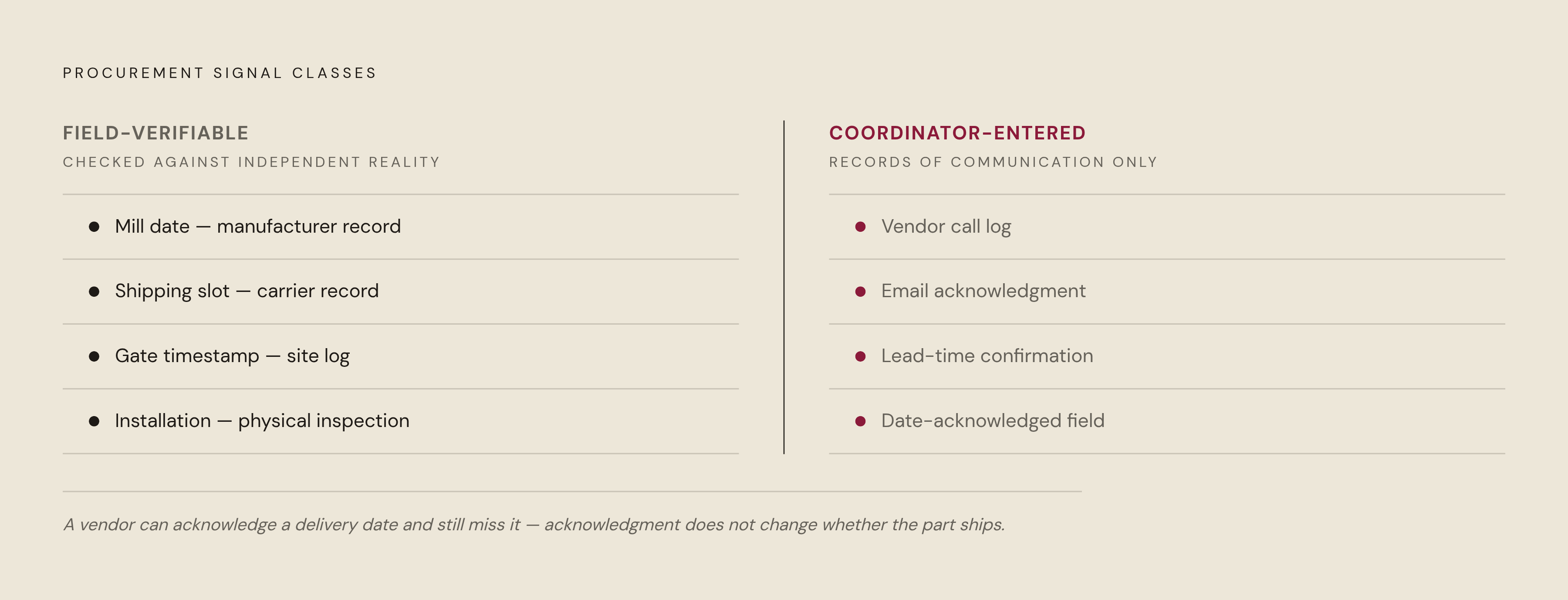
Genuine procurement evidence and procurement theater are separated by one question: does the underlying signal come from an independent, field-verifiable source, or was it entered by a coordinator based on a conversation? Field-verifiable signals include confirmed mill dates from the manufacturer, shipping slot assignments backed by carrier records, gate entry timestamps logged at the receiving site, and installation progress tied to a physical inspection. Each of these has a source that exists independently of whether the vendor happened to acknowledge a schedule on a phone call. Coordinator-entered signals include vendor call logs, email acknowledgments, lead-time confirmations, and the date-acknowledged fields common in procurement trackers. All of these are records of communication rather than records of production or shipment.
The distinction carries real operational weight because one class of signal can be checked against reality and the other cannot. A vendor can acknowledge a delivery date and still miss it, because the acknowledgment itself does not change whether the part ships. A shipping record, by contrast, either exists or it doesn't. In accelerated project delivery, sourcing often begins before design work is even finalized, so every component eventually has to be traced back to its actual source as part of proactive supply chain management, and that calls for a data structure a call log was never built to support.
A P6 schedule file captures the planner's intent for how a project is supposed to unfold. It does not, on its own, confirm whether that intent is achievable, because the logic in the file is built from assumptions about durations and dependencies rather than from verified facts about where materials actually stand. Field-verifiable procurement signals are the only way to know whether the sequence the schedule assumes is realistic, and the gap between the schedule's logic and the facts on the ground is exactly where schedule risk lives. No matter how often you update a report built around acknowledgment fields, you cannot close that gap this way.
Applying AI to an unredesigned expediting process
An automated expediting system that pings vendors, logs their responses, and populates a dashboard is faster theater, not better evidence. The underlying signal captured by that system is still coordinator-entered, just generated by software instead of a person on the phone, and applying AI to it scales up the production of artifacts without touching the gap those artifacts were always failing to close.
This is a recognizable failure pattern in enterprise AI deployment more broadly: a workflow gets automated rather than redesigned. If you layer an intelligent agent onto a process built to produce artifacts, you get more artifacts, produced faster, carrying a higher apparent credibility than the manual version ever had, because software updated a dashboard instead of a person filling out a form. Poor data does not just limit how well an AI system performs. It delivers flawed outputs at scale, which makes bad automation more costly to an organization than having no automation. A dashboard showing confident, green-lit procurement status on a part that has not actually shipped is more dangerous than an empty field, because an empty field at least invites someone to go check.
AI has a legitimate and substantial role to play in procurement: demand forecasting, supplier-risk analysis, inventory optimization, and logistics planning are all areas where the right models, applied to the right data, produce real value. None of those capabilities correct for a reporting structure that treats a vendor's acknowledgment of a date as confirmation that the date will be met. The question any AI deployment in this space should force is simple: what is this process actually trying to confirm? Asked honestly, that question almost always points to a different workflow from the one already in place, one anchored to field-verifiable signals rather than to call logs dressed up as dashboards.
Rebuilding expediting as a genuine risk signal
Rebuilding expediting as a real risk signal means redesigning the process around field-verifiable inputs first, and only then deciding what to automate. The sequence matters as much as the technology chosen, because automating the wrong sequence just produces the failure pattern described above, faster.
The work starts with a process audit: map out how an expediting report gets produced today, trace each data field back to where it actually originates, and sort the fields into what can be independently verified and what cannot. That audit alone tends to surface the theater in a process long before you select any tool. From there, the data structure itself needs to change: coordinator-entered acknowledgment fields get replaced with structured inputs tied to external verification, mill certificates, carrier booking confirmations, site gate records, so that the report's content carries an independent check rather than resting on a vendor's word. Procurement signals also need to feed straight into the scheduling layer, not sit in a separate tracker that schedule managers may or may not read. A confirmed shipping slot for a critical transformer ought to trigger an update to the energization sequence itself, not wait for someone to notice it during a status meeting.
AI agents have a real place inside a workflow built this way: monitoring for confirmation gaps, flagging when a shipping slot has not been assigned by a given threshold date, correlating lead-time data against available schedule float. None of that works if it is bolted onto the existing reporting layer after the fact instead of built into a redesigned process from the start. The practical difference comes down to whether a signal can be verified against sources outside the vendor's own acknowledgment: mill dates, carrier records, gate entry timestamps, and inspection-tied progress all have a source that exists whether or not the coordination call ever happened. If you rebuild a process around those signals, instead of just automating coordinator logs, you get genuine schedule risk management rather than schedule optimism.
Legislative and regulatory momentum is moving in a similar direction. H.R. 3838, the FY2026 NDAA, passed the House on September 10, 2025, and was received in the Senate on September 30, 2025, and GSA's procurement streamlining proposals from July 2026 both push toward greater efficiency and accountability in how procurement gets executed. Procedural reform at the regulatory level does not, by itself, fix the data structure sitting inside a project team's expediting process. That still requires deliberate redesign at the operational level, one process at a time. Terminal Use starts that redesign by looking at how a process actually runs today and where it causes pain, before deciding what to rebuild, because you cannot produce procurement intelligence if you automate a broken expediting process. It produces a faster, more credible-looking version of the same gap.
Sources
- Text - H.R.3838 - 119th Congress (2025-2026): Streamlining Procurement for Effective Execution and Delivery and National Defense Authorization Act for Fiscal Year 2026
- PROCUREMENT STREAMLINING & BUILDING THE INDUSTRIAL BASE SEC.
- Terminal Use | Whole departments, rebuilt to run AI-first, for construction, logistics, manufacturing, and retail
- Expediting Services