Customs and Import Clearance Delays on Critical Plant Equipment
Tariff changes and fragmented oversight are compounding equipment clearance delays on job sites.
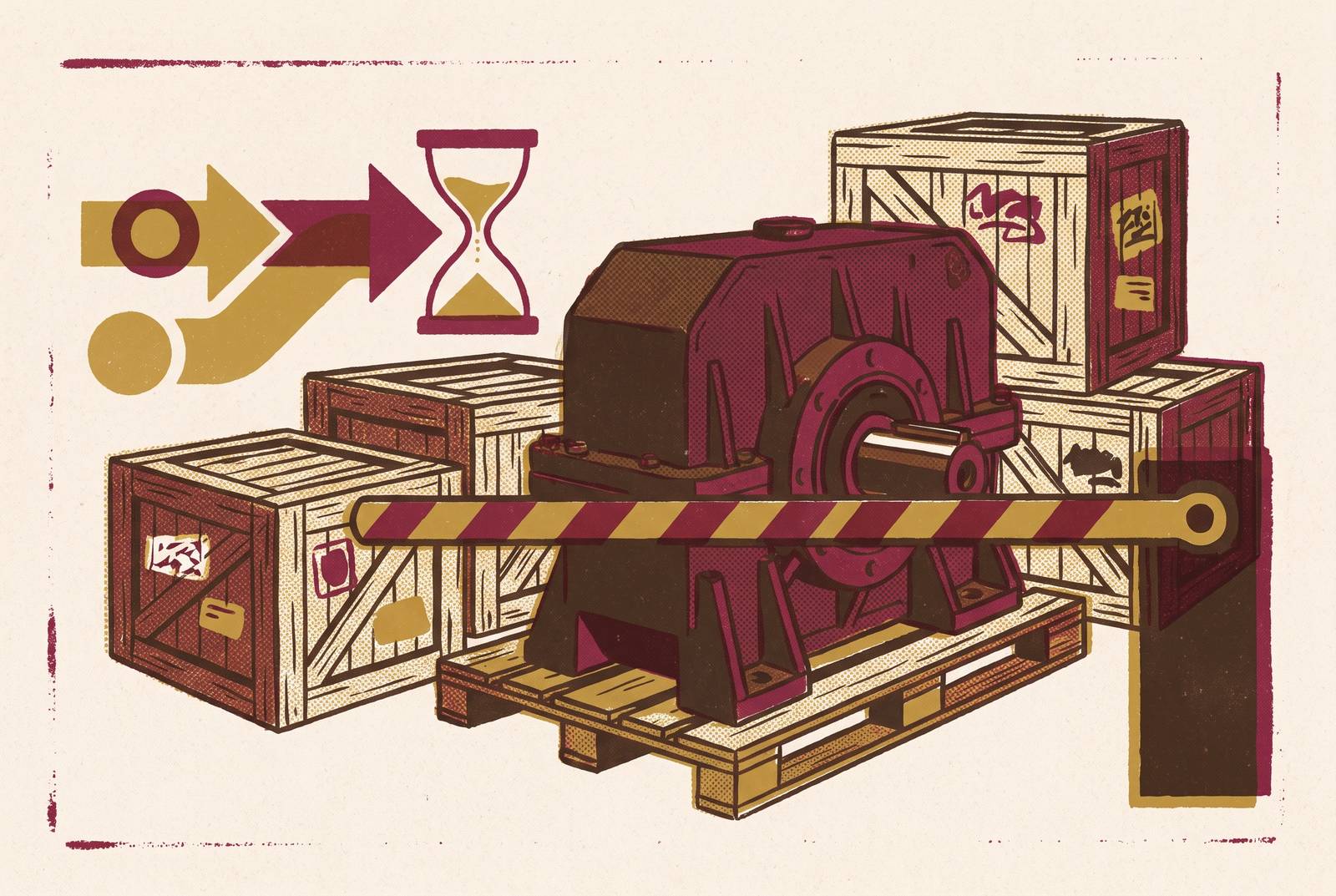
A single excavator held at a port of entry can stop a job site that has nothing to do with excavation. Construction schedules treat equipment delivery as a fixed point, and mechanical, electrical, and structural trades sequence their own work around that date. When a crane, generator, or excavator sits in a bonded warehouse waiting on a customs release, the trades that depend on it cannot proceed because everything scheduled after it has nowhere to go. A 2025-2026 enforcement environment keeps shifting underneath procurement decisions made months earlier, including new CBP vetting requirements for foreign Importers of Record and a Section 232 tariff revision effective June 8, 2026 covering bulldozers, graders, loaders, excavators, forklifts, and cranes, putting clearance on the critical path.
Heavy equipment and the compounding of ordinary freight clearance problems
Plant equipment does not just cost more than standard freight. It carries more ways to fail at the border. Declared value is a related exposure. Capital equipment like tower cranes and large generators invites reassessment, and any gap between what was declared and what customs assesses extends the hold. Project cargo makes this harder still. None of this complexity resolves itself. It demands more coordination across the people handling it, not less, which is exactly where the next problem begins.
Fragmented ownership across procurement, logistics, and finance turning compliance into a gap
Most clearance failures on critical plant equipment are not the product of random enforcement or bad luck. They trace to a simple structural fact: three functions each hold part of the compliance chain, and none of them owns the whole of it. The result appears in inconsistent paperwork, incomplete documentation, and missing certificates because no single person or team ever had the full picture to check against, even though everyone involved was careful. Without that level of detail, no one can see where a delay is actually forming or how it will ripple into field sequencing once it does. The 2026 regulatory calendar makes the cost of this fragmentation sharper. In organizations where ownership is split three ways, that alignment often doesn't happen until the cost difference appears somewhere unexpected.
Tariffs and Fragmentation Risk on Plant Equipment
The June 1, 2026 announcement, with changes effective June 8, 2026 through December 31, 2027, reduced Section 232 tariffs to 15 percent on a broad category of construction equipment, including bulldozers, graders, loaders, excavators, forklifts, cranes, and related parts, but only for imports from qualifying trade-deal countries. Equipment from every other origin still carries the 25 percent general rate. Procurement decisions made before June 2026 were built on a cost basis and classification structure that may no longer match what's in effect by the time the equipment actually ships. The relief is temporary and runs only through the end of 2027, so projects with long lead times are sourcing equipment today against a tariff structure that could shift again before that equipment leaves the factory. If you locked in a purchase order six months ago, the declared value on the eventual customs entry may be moving against a rate the original budget never accounted for. Caterpillar's own Q1 2026 results make the scale of this pressure concrete: the company reported $710 million in unfavorable manufacturing costs, largely tariff-driven, with tariff costs specifically running approximately $600 million for the quarter, and projected full-year 2026 tariff costs between $2.2 and $2.4 billion. That is the cost pressure moving through the equipment manufacturers themselves, and it tends to show up downstream in fabricated product and component pricing that often exceeds the raw material tariff cost outright, a detail that most fragmented budget processes never capture because no one function is tracking the full chain from raw material to finished machine to customs entry. When procurement, logistics, and finance aren't aligned on the current classification, duty rate, and refund eligibility for a given piece of equipment, the project is carrying cost and delay exposure that none of the three functions can see on its own.
The clearance process with no end-to-end owner
Fragmented ownership rarely produces one dramatic failure. It produces a series of small gaps that accumulate into a hold nobody saw coming and nobody is positioned to resolve quickly. Missing or incorrect commercial invoices, packing lists, or certificates of origin remain among the leading causes of customs holds, and for plant equipment the required documentation runs deeper than most ordinary freight: machine type, specifications, serial numbers, intended use, and permits such as emissions compliance all have to line up. That detail doesn't assemble itself across a chain where three different functions each hold a different piece of it. Even minor inconsistencies stop the process cold: a wrong consignee detail, a product description that doesn't match across documents, a weight that doesn't reconcile with the bill of lading, any of these can generate a query that pauses the entry while someone tracks down the correct answer. A Tier 3 Intensive Exam, involving full unloading, counting, and inspection at a Customs Exam Station, adds real time to clearance, and for oversized plant equipment this is a live risk. When procurement owns the supplier relationship, logistics owns the broker relationship, and finance owns the duty payment, a CBP request for additional evidence touches all three at once, and the response time ends up set by whichever function is slowest to engage, regardless of which one actually holds the missing document.
Patching the compliance process versus closing the ownership gap
The instinctive response to repeated clearance delays is to add a checklist, brief the broker more often, or bring on another logistics coordinator. These moves have real value, but they address symptoms sitting on top of a structural cause that they never touch. A checklist works when one function owns the full sequence end to end. When ownership is split across three functions, a checklist turns into a handoff document that each group fills out in isolation, with no one checking that the pieces are consistent with each other once assembled. Real-time tracking tools genuinely improve visibility into where a shipment sits at any given moment, but seeing a hold faster isn't the same as resolving it. Visibility only helps if someone with real authority is positioned to act on what it shows. The strongest case against this argument is that most organizations have already invested in compliance tools and broker relationships, and that whatever delay remains is simply variance no process change can remove. That case misses something specific: the delays that process investment has already reduced are the easy, predictable ones, familiar documentation formats, known classification categories, suppliers everyone has worked with before. What's left is the harder structural layer: novel equipment categories, tariff classifications that change mid-project, multi-shipment project cargo spread across entries and brokers, and IOR requirements that cut across functions by design. The 2026 CBP calendar keeps adding to that layer. Foreign IOR vetting effective August 18, 2026 doesn't fit cleanly into procurement's remit, logistics's remit, or legal's remit, and organizations that haven't settled who owns it will meet the requirement as a surprise. AI-based document processing tools can extract data from commercial invoices and packing lists at real scale, and that capability is genuinely useful. But AI and automation need structured input to work with: centralized intake, standardized forms, consistent classification across entries. A fragmented process doesn't produce that input. Automating a fragmented process just makes the fragmentation move faster.
What end-to-end ownership of the customs compliance chain requires
Solving this means assigning ownership of the full customs compliance chain to one operational process, with procurement, logistics, and finance feeding into it rather than each running its own separate track in parallel. A procurement record for critical plant equipment should track, at minimum, engineering completion, submittal approval, PO release, fabrication, factory testing, shipping, customs clearance, and required-on-site date as separately owned events, not one promised delivery date standing in for all of them. The customs entry package itself, the HTS code, declared value, certificates, and ISF filing, should be built against a single internal standard with one owner checking consistency across every document, rather than assembled in parallel by the broker and logistics working from different assumptions. Classification decisions on specialized or hybrid equipment need to be made by someone with the authority to bind procurement, logistics, and the broker to one consistent position well before the shipment reaches the port, not negotiated under pressure once a hold is already in place. IOR eligibility and vetting, now a heightened CBP requirement as of August 18, 2026, belongs in procurement as a qualification step taken before a supplier is chosen. Because customs holds collapse an entire project sequence rather than pausing one isolated shipment, clearance deserves treatment as a critical path item with its own lead-time buffer and its own governance, not as a transactional logistics task handled after the fact. Firms that specialize in rebuilding industrial operations workflows, Terminal Use among them, often find that by the time a hold becomes visible to the field, the damage to sequencing is already baked into the plan. The audit has to start further upstream, at how clearance risk gets surfaced to site schedulers and trade foremen first. Terminal Use builds this kind of ownership into the operation itself. The approach starts with a process audit, mapping how the customs compliance chain runs today, where the handoffs sit, and where the gaps are, before any redesign work begins around a single owner and one coherent data flow. The rebuild gives AI agents clean, structured inputs, classification, documentation, IOR status, tariff basis, to work from instead of bolting a tool onto the existing fragmented process, and the first redesigned process tends to go live in weeks. The entry point is always a specific, painful process: for many EPC and construction clients, that means starting with the clearance workflow for one equipment category or one trade corridor, getting that right, and expanding outward from there. If you want to move in smaller steps before committing to a full redesign, other options address real pieces of the same problem. C-TPAT validated customs brokers, such as TLR, which is preparing specifically for the foreign IOR changes directed by Executive Order 14411 in June 2026 and for CBP's August 12, 2026 CTPAT Alert on broker responsibilities, offer a measure of CBP trust status that can cut down on intensive examinations, a genuine reduction in risk.
The procurement record changes that give operations leaders early warning instead of late discovery
Most customs delays on critical plant equipment appear in the procurement record long before they turn into a hold at the port, if the record is structured to show the gap between what's been declared and what's actually ready. If a record shows only a single delivery date, it cannot distinguish a shipment that's genuinely on track from one that has finished fabrication but not factory testing, or shipped without filing ISF, or arrived without its emissions certificate, and each of those situations carries a different risk and a different timeline to fix. Breaking the record into discrete tracked events, each with an owner and an actual date measured against the planned one, makes it possible to spot a customs readiness gap back at the procurement stage, before it reaches the port. For tariff-sensitive categories, excavators, cranes, generators, and the rest of the equipment now sitting under the revised Section 232 structure, the classification and tariff basis belongs in the procurement record itself, reviewed whenever the regulatory picture changes rather than assumed to hold steady from PO release all the way to delivery. Customs clearance fails for plant equipment not because procurement, logistics, and finance are incompetent, but because each owns a piece of the compliance chain and none owns the whole of it. Rebuilding the process means redesigning clearance as one workflow running end to end, from HTS classification and valuation through final exam clearance, rather than patching the handoffs between departments after the fact. A P6 schedule showing equipment delivery on day 90 doesn't say whether the HTS code is correct, whether the IOR has been vetted, or whether the certificate of origin matches the commercial invoice. The schedule shows intent. It doesn't show readiness. Operations leaders who treat the compliance chain as a data problem, one that should generate a clearance-readiness signal at the same level of detail as a fabrication milestone, are positioned to catch a problem before it becomes a hold. Those who treat it as a logistics execution problem find out about the hold only after it has already eaten into the schedule's float. The right question at every equipment procurement checkpoint is whether the compliance package is complete and consistent and whether the current tariff basis still matches what finance built into the budget.