The Dispatch and Delivery Processes Construction Operations Managers Should Automate Before Signing Any Enterprise AI Agreement
Automate these five workflows before your AI vendor claims it can run your construction site.
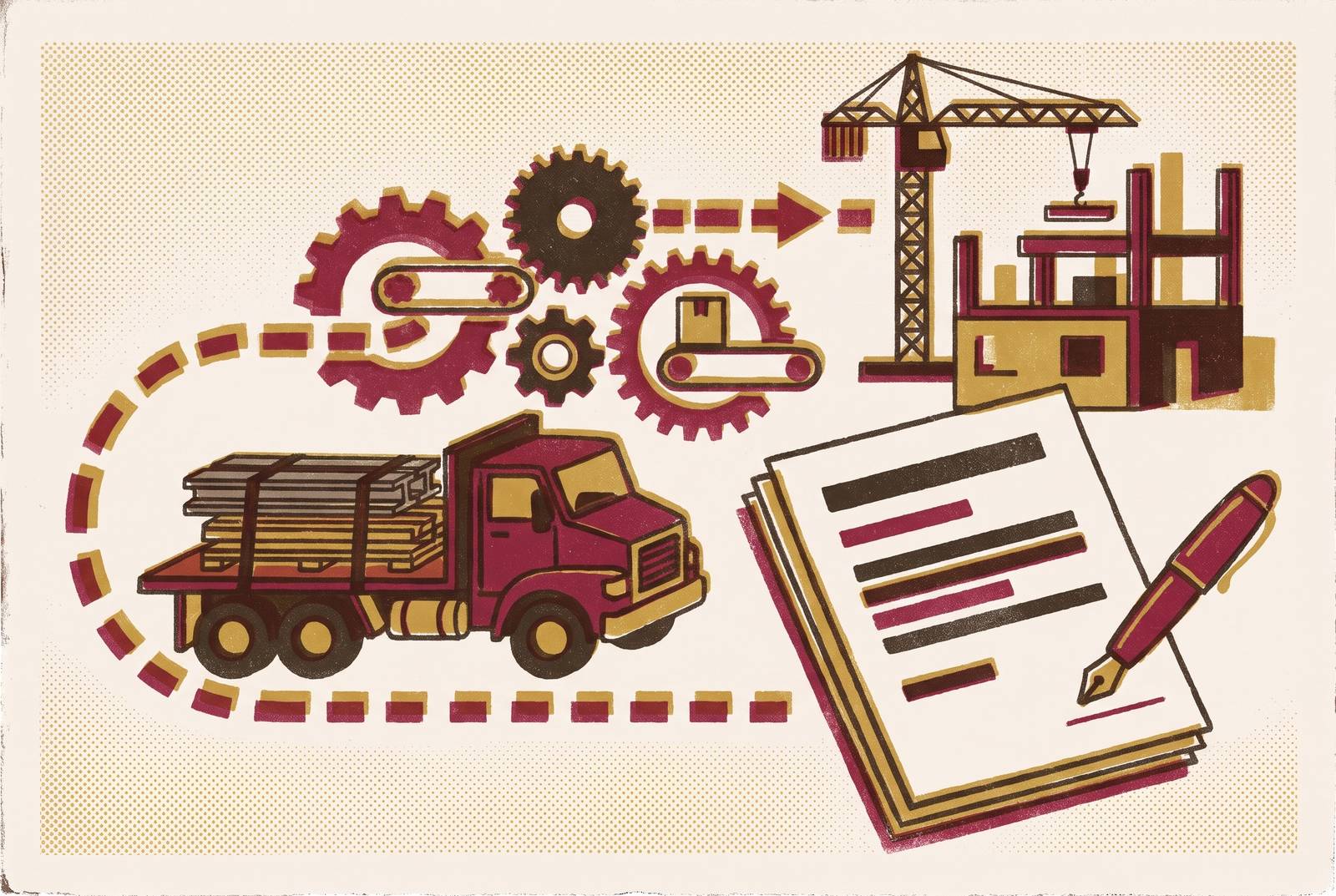
Fast-cycle AI operations deployment in construction starts with dispatch and delivery processes. Operations managers should audit and automate delivery capture, vendor commitment tracking, readiness checks, disruption detection, and evidence continuity before signing. These workflows shape whether AI gets live operational facts or an account put together later, and how well they work gives managers a way to judge a vendor’s promises.
Why dispatch and delivery workflows are where AI fails first in construction
A WhatsApp thread can be the operational record of a construction delivery while the project management system shows something else. A foreman acknowledges receipt, a supplier revises a commitment by phone, and a handwritten gate log records what arrived. The formal system catches up later, after someone interprets those exchanges. That delay creates two versions of the project. One directs work on site, while the other supplies the data an AI vendor expects to integrate with.
This split is more than an integration inconvenience. Where the operational record and the system of record are the same, an AI tool can work from events already captured in a usable form. In construction, it can instead inherit a cleaned-up account that omits unresolved discrepancies and emerging delays. Autodesk’s State of Design & Make construction report found that just 32% of construction leaders say they have met or are close to meeting their AI goals. That finding reinforces the need to examine deployment conditions.
What "dispatch and delivery" actually covers in a construction operation
Construction dispatch and delivery spans five connected processes, which are material delivery confirmation and PO reconciliation, vendor lead-time and delivery risk tracking, construction and energization readiness sequencing, schedule dispatch and re-sequencing under disruption, and compliance evidence continuity. There is no single owner of this record. Procurement, project controls, site foremen, and subcontractors each handle part of it through ERP systems, project management platforms, mobile apps, and paper. People also use informal channels, so one person may know of a change that another has not heard about.
That structure differs from the logistics environment for which delivery management tools were built. Route optimization, predictive demand forecasting, real-time exception handling, and automated customer communication need structured data and a system of record they can rely on. Construction cannot assume that foundation already exists. A delivery status must show that material reached its destination and link it to a purchase order, an installation activity, and, in time, the evidence for that activity.
Material delivery confirmation and PO reconciliation — the first place to look
An early delivery can clog a site and create material management problems, while a late delivery can stop work. Both show why delivery information needs to arrive on time, but what happens at receipt also needs a closer look. An informal acknowledgment of material arriving at the site gate can obscure a discrepancy between the delivery and the order. If the discrepancy remains on a paper ticket, procurement and project controls may continue working from the expected delivery.
Three-way matching compares the delivery slip, purchase order, and invoice. It is a familiar accounting control, yet field operations routinely bypass it because the records do not come together at the right time. An AI agent cannot match an event it cannot see. If a ticket reaches an office administrator three days after receipt, automation has no timely delivery record against which to reconcile the order. The first process to automate is therefore digital confirmation at the gate, tied to the PO.
iFactory describes AI flagging inbound PO mismatches at receipt, before a shortage exposes them. The construction equivalent is detection at the site gate, before missing material becomes a work stoppage. Timing changes the purpose of the control. A mismatch found at receipt can help teams decide what to do, while one found during later reconciliation explains a problem that may already have affected work.
Vendor lead-time risk and procurement correspondence — where commitments disappear
A supplier may warn of a likely delay in an email, a phone call, or a portal update weeks before the delivery date. Yet that information can remain in a procurement inbox until a weekly meeting brings it to site leadership. The warning exists, but it does not travel. By the time project controls receives it, the opportunity to adjust the schedule may have narrowed or closed.
What is missing is a process that links correspondence to delivery commitments, purchase orders, and project milestones. Without it, procurement can know that a supplier’s position has changed while the schedule still reflects the original promise. AI agents can extract commitments and flag divergence, but only where they can read the correspondence and interpret what has been committed. Scattered threads and informal call notes are not, by themselves, a dependable input. The tracking workflow must be able to use what those threads and notes say.
The audit should therefore begin with vendor communication. Operations managers should establish where commitments live, who tracks them, and how quickly a changed date reaches someone able to act. Ownership is as important as access to correspondence. A system that identifies a delayed commitment without connecting it to the affected milestone has not closed the operational gap.
Energization and readiness sequencing — where dispatch errors become commissioning failures
Energization readiness for MEP and electrical scopes depends on several conditions being true together, including equipment on site, installation complete, inspection passed, and utility coordination confirmed. A failure at any link can delay commissioning, with schedule consequences measured in weeks. Delivery is an upstream dependency because equipment must arrive before the installation and inspection sequence can proceed. It is not a separate logistics concern that can be resolved without reference to readiness.
That dependency is especially at risk with long-lead electrical and mechanical equipment. If its expected arrival falls after the planned installation date, the conflict should be visible before crews are standing idle. Separate records can hide that conflict until work begins. Procurement may track deliveries while another team keeps the installation schedule, so neither record shows the full prerequisite chain. An AI readiness tool cannot reliably check that chain if it cannot see whether the delivery condition has been met.
A concrete pour illustrates the same logic at a smaller scale. Field readiness checklists cover crew, materials, weather, and inspection status, and a gap in any one indicates an unready state. Generating the checklist is not the decisive control. The audit must check whether the prerequisite chain is written down, whether people follow it, and whether a failed check actually stops the scheduled activity. Otherwise, automation records unreadiness without preventing execution.
Scheduling dispatch and re-sequencing under disruption — when the plan meets the site
A material delivery slip, equipment breakdown, or crew shortage can change the critical path, but a static schedule changes only when someone updates it. In many organizations, that update lags by days. In the meantime, dispatch decisions can still be based on conditions that have changed. The schedule remains orderly while the site has changed.
AI scheduling tools can show re-sequencing options, how they would affect resources, and what they would mean for work that depends on those activities. Those capabilities are useful, but their value depends on when the triggering event becomes visible. A dispatcher who learns of a delayed delivery from a foreman’s morning report is asking the tool to process yesterday’s problem. Better analysis cannot recover the lost warning time. Firms should therefore put disruption detection in place before they automate re-sequencing.
That means automating the workflow that surfaces a delivery exception, equipment failure, or failed readiness check and routes it to the relevant decision-maker. LogiNext frames AI exception management around early detection and corrective action before disruptions affect customer satisfaction. The construction parallel is scheduled work. The audit should establish whether the exception reaches the dispatcher before its consequences reach the activity.
Compliance evidence and audit-trail continuity — the hidden dispatch problem at handover
At handover, inspection records, delivery confirmations, installation stage documentation, and test results may exist without forming a usable evidence trail. Different subcontractors hold different records, uploads are inconsistent, and documents are not always connected to the installation event they are supposed to prove. Finding a file is only part of the task. Delivery teams must also establish that it supports the completed scope, which requires locating and validating records that should already be connected.
A confirmation captured at receipt and tagged to the relevant PO and schedule activity would be available later without reconstructing that relationship. Without those connections, handover inherits the uncertainty of receiving. AI retrieval tools may help put scattered evidence in order, but automating the search leaves the process that scattered it unchanged.
Evidence continuity therefore belongs in the dispatch audit as well as a handover review. The test is whether the operational event and its supporting record remain connected throughout the project. A message thread may suffice to coordinate immediate work. At handover, however, relying on WhatsApp as the operational record creates legal and contractual difficulties because the project must substantiate what was delivered, inspected, installed, and tested.
What should operations managers audit before evaluating an AI vendor’s claims?
The vendor meeting should begin with the five failure zones and the operation’s actual records. A demonstration uses clean, structured, timely data, which makes it a poor substitute for examining implementation conditions. The relevant comparison is with the site’s own workflow. Operations managers should ask how the proposed system will close each gap rather than accept integration as proof that the underlying process is ready.
For material receiving, the question is whether every delivery is captured digitally at receipt and reconciled against the PO within the same day. For vendor risk, it is whether a supplier delay signal reaches project controls and site leadership within hours or days. These questions test latency as well as completeness. A record can be accurate when finally entered and still arrive too late to support the decision it was meant to inform.
For readiness, managers should ask whether a failed prerequisite stops a scheduled activity or people just note it and work around it. For disruption detection, they should establish whether a delivery exception reaches the dispatcher before or after scheduled work is affected. Compliance requires a different test of the same chain. Can the delivery confirmation, inspection record, and installation stage documentation for a completed scope be found quickly and without difficulty?
Each unsatisfactory answer should lead to an implementation question for the vendor. The vendor needs to explain how its system handles the gap before implementation, rather than demonstrate what happens once someone else has supplied complete data. Connectivity alone is not the acceptance test. Locus advises enterprise buyers to check integration readiness when judging AI claims, but in construction they also need to check whether the connected systems have records that are correct and up to date. A vendor unable to address that distinction is proposing automation around the gap.
Why fixing these processes before signing matters more than which AI platform you choose
A platform decision is reversible, while the data and process decisions made during implementation are harder to unwind. A firm that makes delivery capture digital and sets up a way to track vendor communication before signing can later change platforms without building those practices again from scratch. Signing first changes the conditions of that work. The firm must then introduce process discipline and implement technology simultaneously, under contract pressure, while unresolved responsibilities complicate both tasks.
The move toward AI as a built-in assistant does not remove this dependency. Summarizing RFIs, drafting meeting recaps, organizing punch lists, and identifying schedule or cost risks can support teams, but operational judgments still depend on the records available. An assistant cannot treat an unreported delivery failure as known. The closer AI moves to daily decisions, the more consequential the timing and accuracy of event capture become.
The audit is therefore not a requirement to automate everything before discussing an agreement. It is a way to enter that discussion knowing where the workflow breaks and what the vendor must bridge. Knowing this puts the operations manager in a stronger position to negotiate. Instead of accepting a general promise of rapid deployment, the manager can ask which missing event, commitment, prerequisite, or evidence link the implementation will address. Those questions show what integration will need to cover before those needs turn into disputes over the contract.